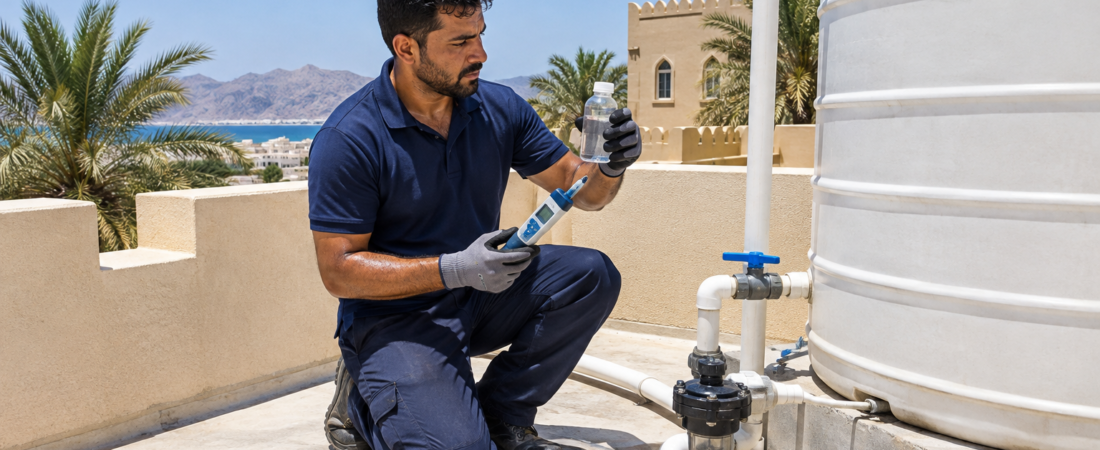
Ask five neighbours in Muscat what their water reads and you will get five different answers. Water TDS in Muscat by area varies less because of the postcode and more because of where your building actually gets its water: mains from a desalination plant, a borehole, a tanker, or some mix of all three. This guide shows the bands we record on service calls, how to read your own meter, and what to do with the number once you have it.
In this guide
- Your supply matters more than your area
- Water TDS in Muscat by area: the bands we see
- Why your roof tank raises the number
- TDS is not hardness
- What to fit at each band
- Test it yourself in two minutes
- FAQ
Your supply matters more than your area
Greater Muscat is supplied largely from desalination. Desalinated product water leaves the plant low in dissolved solids, which is why a tap in Al Khuwair and a tap in Seeb on the same network often read within a few tens of mg/L of each other.
The wide variation starts where mains supply thins out. Properties on the edges of Amerat, up the wadis, on farmland, or in compounds topped up by tanker can read ten to twenty times higher than a mains apartment two districts away. That is the real driver behind water TDS in Muscat by area.
Water TDS in Muscat by area: the bands we see
| Area / property type | Usual supply | TDS band (mg/L) |
|---|---|---|
| Al Khuwair, Azaiba, Ghubrah, Qurum, Ruwi apartments | Mains, desalinated | Low: 100 – 350 |
| Seeb, Mabela, Mawaleh, Al Hail villas on mains | Mains with roof tank | Low to moderate: 150 – 500 |
| Bousher, Ansab, Ghala villas | Mains, some tanker top-up | Moderate: 250 – 700 |
| Amerat outskirts, wadi-side properties | Mixed mains and well | Moderate to high: 500 – 1,500 |
| Farms and estates, Quriyat, Barka road, interior | Borehole | High: 1,500 – 6,000+ |
| Labour accommodation and camps on tanker | Tanker, variable source | Unpredictable: 300 – 3,000 |
These bands come from our own meter readings across hundreds of service visits, not from a published municipal dataset. Treat them as a starting expectation, not as your building’s figure. Two villas on the same street can differ if one is on a well.
Why your roof tank raises water TDS in Muscat
Water TDS in Muscat by area tells you what arrives at your building. Your kitchen tap can read something else entirely. Three things push it up:
- Evaporation. A poorly sealed tank on a Muscat roof in July concentrates whatever is inside it.
- Tanker top-ups. One 4,000 mg/L delivery into a half-full tank shifts the whole tank.
- Sediment. Years of settled solids stir back into the water every time the level drops fast.
If your reading is higher than the band above suggests, clean the tank before you buy anything. Our water tank cleaning guide covers the 8-step process.
TDS is not hardness
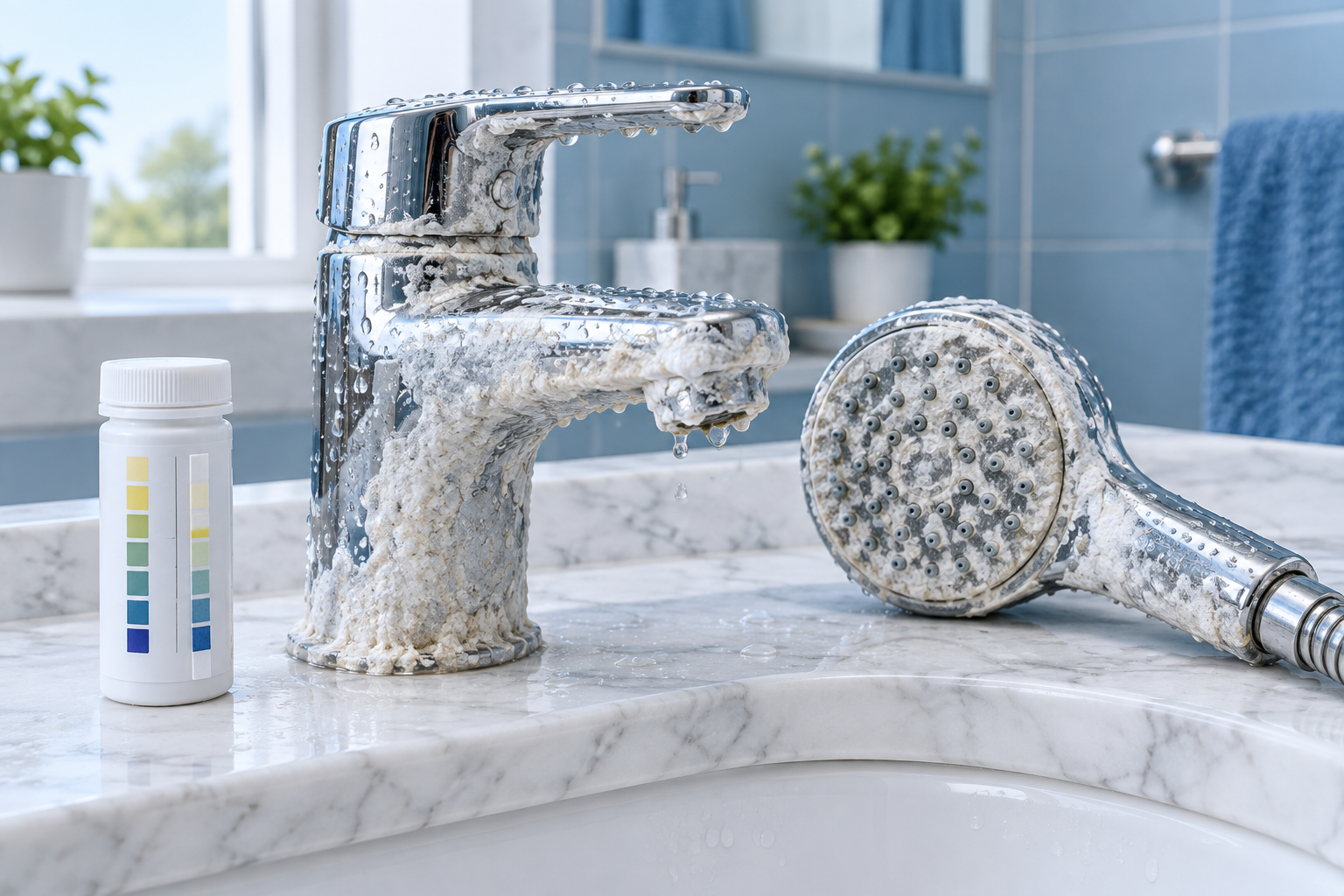
A meter gives you one number for everything dissolved. It cannot tell you how much of that is calcium and magnesium, which is what actually scales your water heater and ruins your shower head. A villa at 600 mg/L that is mostly sodium chloride needs RO. A villa at 600 mg/L that is mostly calcium bicarbonate needs a softener. Same number, different equipment, very different cost. We take this apart properly in hard water vs high TDS in Oman.
Water TDS in Muscat by area: what to fit at each band
| TDS reading | Sensible step |
|---|---|
| Under 350 | Under-sink RO or a good carbon unit for drinking; nothing needed whole-house |
| 350 – 700 | Test hardness. Softener if hardness is high, drinking RO either way |
| 700 – 1,500 | Whole-house filtration plus softener, drinking RO. See whole house water filter in Muscat |
| Above 1,500 | Full pre-treatment then RO, sized on a lab analysis. See well water treatment in Oman |
Once you know where you sit on water TDS in Muscat by area, pricing for each of these sits in our 2026 water filter price guide.
Test it yourself in two minutes
- Run the kitchen tap for 30 seconds so you are sampling supply, not standing water in the pipe.
- Fill a clean glass. Let it sit until it is at room temperature; a cold sample reads low.
- Switch the meter on, dip it to the marked line, wait for the reading to settle.
- Repeat at a bathroom tap. A large gap between the two means a plumbing or tank issue, not a supply issue.
- Write the number and the date on a note inside your filter cabinet. The trend over a year tells you more than any single reading.
That five-step check is how we log water TDS in Muscat by area on every service call. Meters drift, so if yours has never been calibrated and the number looks alarming, confirm it before spending money.
Water TDS in Muscat: FAQ
What is a safe TDS level for drinking water?
Most guidance treats under 600 mg/L as acceptable for taste and 1,000 mg/L as the upper limit for palatability. Low TDS is not unsafe; see our guide to RO water minerals in Oman.
Is Muscat tap water safe to drink?
Mains supply in Muscat is treated to drinking standard. What happens between the network and your glass, mainly the tank and the pipework, is where most problems start.
Why did my TDS jump suddenly?
Usually a tanker delivery, a switch of supply source, or an RO membrane at the end of its life. Sudden jumps are the most common reason people start looking up water TDS in Muscat by area.
Does high TDS cause limescale?
Only the hardness fraction of it does. Test hardness separately before buying a softener.
This guide is also available in Arabic.
Free TDS and hardness test across Muscat
Published bands are a guide. We will measure TDS, pH, hardness and chlorine at your property and tell you which of the bands above you are actually in, at no charge. Book a free water test in Oman or call +968 9763 7786.