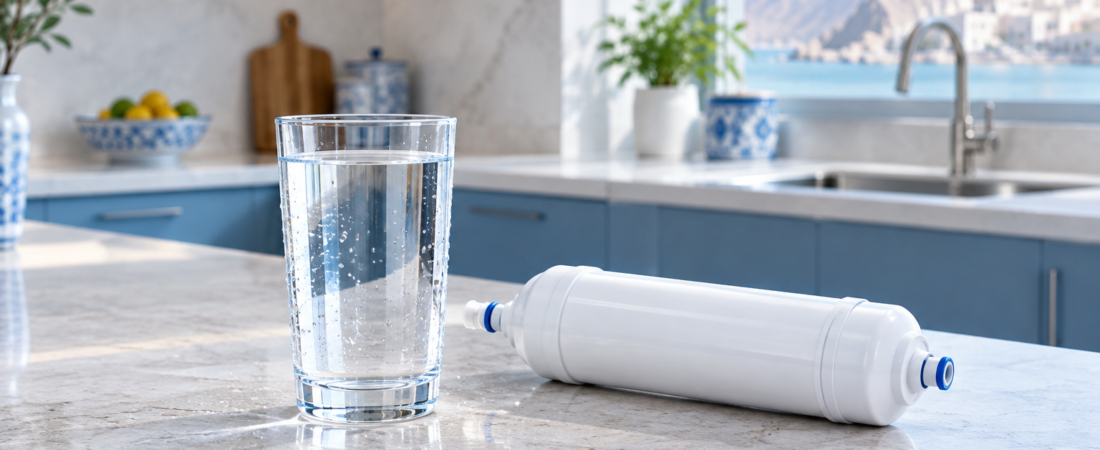
RO water minerals in Oman is the question we get asked more than any other, usually in the same sentence as “is RO water bad for you?” The short answer: reverse osmosis does strip most dissolved minerals out of your water, and for the vast majority of homes in Muscat that is not a health problem. It is a taste problem, and sometimes a plumbing problem. This guide explains what RO removes, what the numbers on your TDS meter mean, and when a mineral or alkaline cartridge is worth paying for.
In this guide
- What RO actually removes
- 7 facts about RO water minerals in Oman
- TDS after RO: the numbers to expect
- When a mineral or alkaline cartridge is worth it
- What we install in Omani homes
- FAQ
What RO actually removes
An RO membrane rejects 90 to 98 percent of total dissolved solids. It does not choose between the solids you want gone and the ones you do not. So along with sodium, chloride, sulphate, nitrate and heavy metals, it also removes calcium, magnesium, potassium and fluoride.
That is the trade-off at the centre of every conversation about RO water minerals in Oman. You cannot get an 8 mg/L glass of water out of 2,400 mg/L well water and keep the calcium. The membrane works on particle size and charge, not on nutrition.
7 facts about RO water minerals in Oman
1. Drinking water is a small part of your mineral intake
For most diets, water supplies a single-digit percentage of daily calcium and magnesium. Dairy, bread, dates, leafy vegetables and nuts do the heavy lifting. Removing minerals from two litres of drinking water a day does not create a deficiency in someone eating normally. If you have a diagnosed mineral deficiency, that is a conversation for your doctor, not your filter supplier.
2. Muscat mains water is already low in minerals
Most of Muscat runs on desalinated supply. Desalinated product water starts out low in calcium and magnesium before it ever reaches your tap. If you are on mains supply in Al Khuwair, Azaiba or Ghubrah, an RO unit is not taking away a mineral-rich water. It is polishing water that was already soft.
3. Well and tanker water is a different story
Interior Oman, farm properties and villas topped up by tanker often test between 1,500 and 6,000 mg/L. Here RO is not optional, and the minerals being removed are mostly sodium, sulphate and hardness salts you do not want to drink or run through a water heater. See our guide to well water treatment in Oman.
4. Low-mineral water tastes flat
This is the real complaint behind most “RO water feels empty” calls. At 5 to 20 mg/L TDS, water tastes thin because there is nothing in it to taste. A small amount of calcium and magnesium put back gives the water body. Taste is a legitimate reason to remineralise.
5. Very low TDS water is mildly aggressive to plumbing
Water with almost no dissolved solids will pick up metal from copper and brass fittings downstream of the filter. In a home with a short run of tubing to the faucet this rarely matters. In a commercial installation feeding a coffee machine, ice maker or boiler, it matters, and we specify a remineralising or blending stage as standard.
6. Alkaline is about pH, not minerals
RO permeate usually sits slightly acidic, around pH 6 to 6.8, because dissolved carbon dioxide passes through the membrane. An alkaline cartridge lifts that to roughly pH 7.5 to 9. That changes the pH reading and the mouthfeel. The health claims made for alkaline water online go well beyond what the evidence supports, and we do not sell on them.
7. Your TDS meter measures quantity, not quality
A TDS meter reads electrical conductivity and converts it to a number. It cannot tell calcium from sodium, and it cannot see bacteria at all. A reading of 180 mg/L of calcium bicarbonate and 180 mg/L of sodium chloride are the same number and very different water. This is the same confusion we unpick in hard water vs high TDS in Oman.
TDS after RO: the numbers to expect
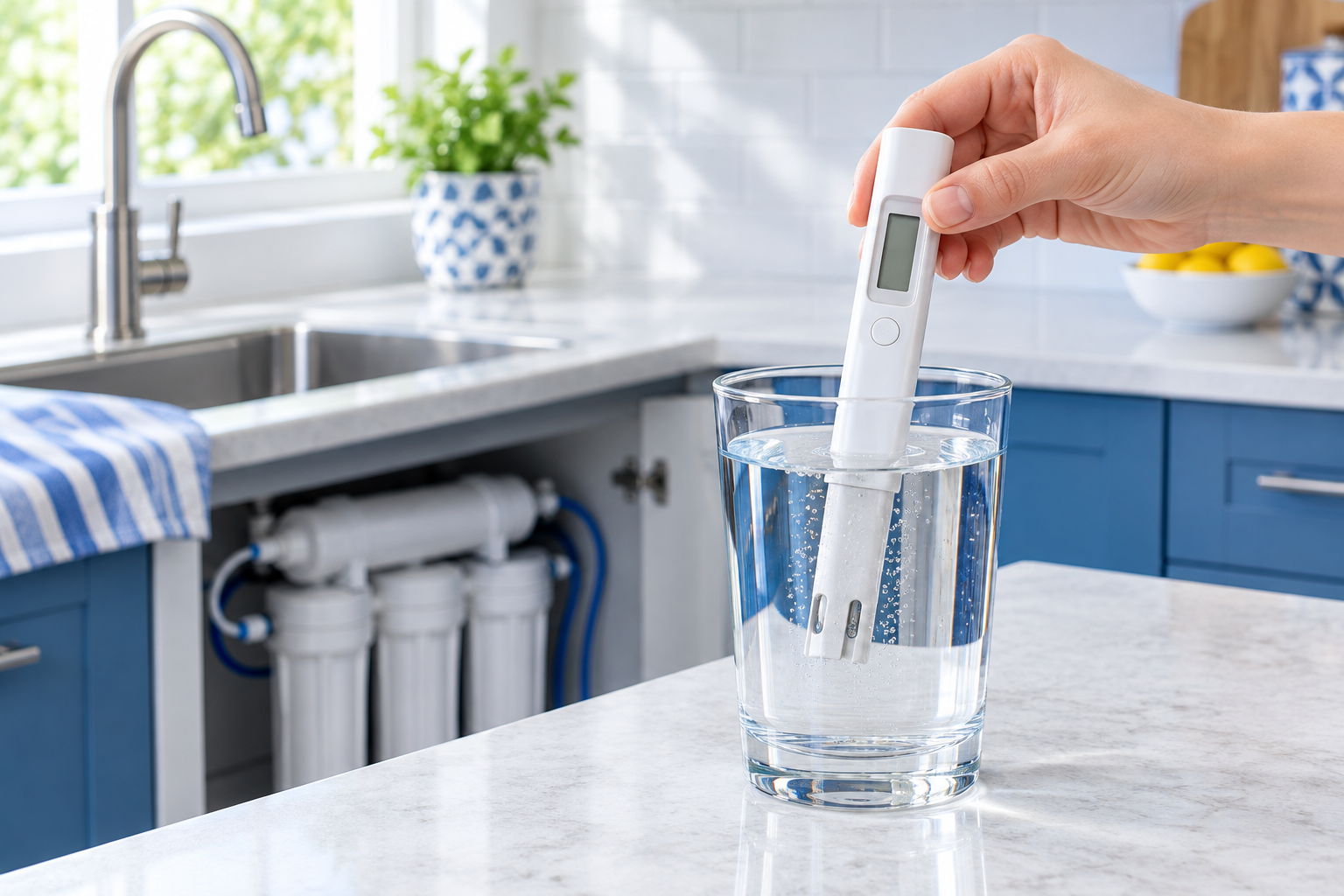
Typical readings we record on service visits in and around Muscat:
| Water | Typical TDS (mg/L) | What it means |
|---|---|---|
| Muscat mains (desalinated) | 100 – 350 | Already soft; RO mainly removes taste, chlorine and traces |
| Mains stored in a roof tank | 150 – 500 | Storage and tanker top-ups raise it |
| Well or borehole supply | 1,500 – 6,000 | RO required for drinking |
| After a domestic RO, no mineral stage | 5 – 30 | Safe, tastes flat, mildly aggressive |
| After a domestic RO with mineral cartridge | 40 – 90 | Rounder taste, pH closer to neutral |
These are ranges from our own service records, not published figures for your building. Your reading depends on your supply, your tank and your last cartridge change.
When a mineral or alkaline cartridge is worth it
Add one if any of these apply to you:
- You or your family say the filtered water tastes flat or metallic
- The RO feeds a coffee machine, espresso group, ice maker or steam oven
- There is a long run of copper or brass pipe after the RO unit
- You are filling bottles for a mosque, majlis or office and taste is being judged
Skip it if you are happy with the taste and the unit feeds only a drinking faucet. It is a cartridge that needs replacing like any other, and it adds to your annual service cost. Our water filter maintenance guide sets out the schedule.
What we install in Omani homes
For a Muscat villa or apartment on mains supply, a 6 or 7 stage under-sink RO with a post-carbon and a mineral cartridge covers almost every case. For well-fed properties we size the pre-treatment first, because a membrane fed unsoftened 3,000 mg/L water will not last a year. Compare configurations in our buyer guide to the best water filter in Oman and check current pricing in the water filter price guide.
If you are still choosing between technologies, RO vs UV water purifier in Oman explains which problem each one solves.
FAQ
Is RO water safe to drink long term in Oman?
Yes, for people with a normal diet. The mineral content of drinking water is a small contributor to intake. This is general information and not medical advice.
Does RO remove fluoride?
Yes, an RO membrane removes most fluoride along with other dissolved ions.
Can I add minerals myself?
An inline mineral cartridge fitted after the tank is the practical way. Adding salts by hand to a jug is not repeatable and we do not recommend it.
What TDS should my RO water be?
Anywhere from 5 to 90 mg/L is normal depending on whether a mineral stage is fitted. A reading climbing past 20 percent of your feed TDS usually means the membrane is failing.
Not sure what your own supply reads? See water TDS in Muscat by area for the bands we measure district by district. This guide is also available in Arabic.
Get your water tested first
Every recommendation above depends on your actual feed water. We test TDS, pH, hardness and chlorine free of charge across Muscat and can tell you in one visit whether a mineral stage is worth fitting. Book a free water test in Oman, or call us on +968 9763 7786.