DM water supply in Oman is a routine purchase for any site that runs forklifts, boilers, chilled water plants, generators or a laboratory, yet most buyers still order it as “pure water” with no written specification. That is how batteries get topped up with water that is barely better than tap, and how a boiler log ends up with no batch record. This guide sets out what DM water is, the numbers to ask for, what it costs per litre, and how to check a delivery before it goes into your equipment.
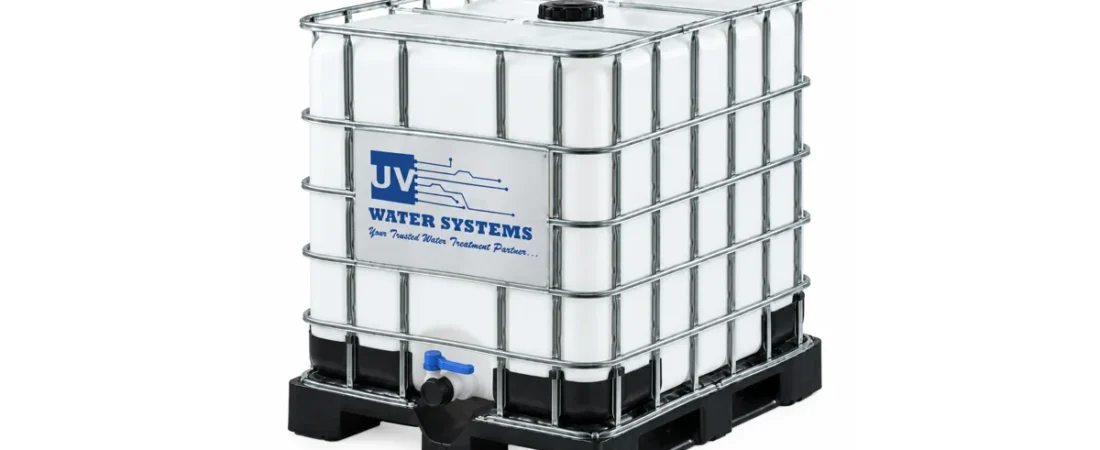
Quick facts from UV Water Systems, Muscat: we produce DM water by reverse osmosis and mixed-bed deionisation, fill it at below 2 µS/cm, and sell it in a 1,000-litre DM water IBC for 130 OMR, which is 130 baisa per litre.
On this page
- What is DM water?
- DM water vs distilled water vs RO water
- DM water specifications to ask for
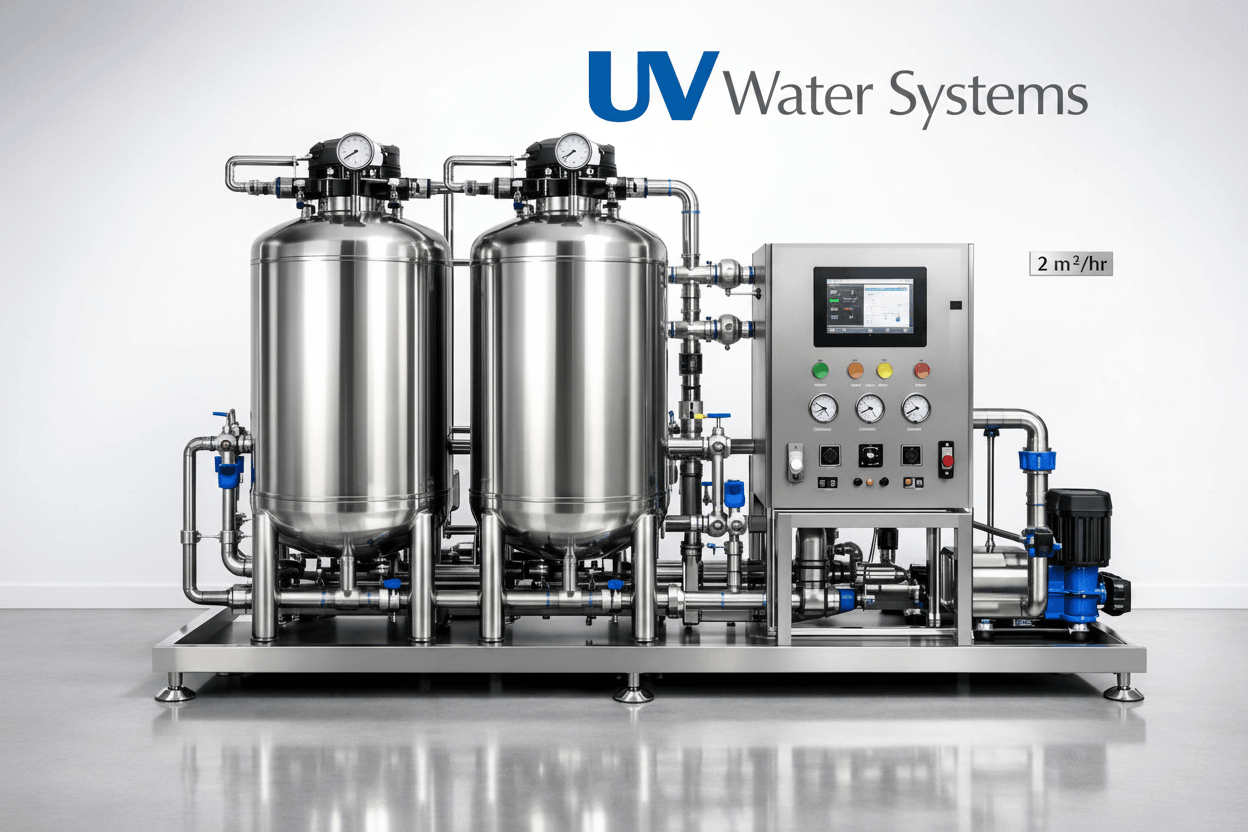
- How we produce DM water in Muscat
- 9 industrial uses for DM water in Oman
- Pack sizes and price per litre
- What drives the price
- How to check a DM water delivery
- Storing DM water in Omani heat
- Common problems when sites skip DM water
- 8 questions before you sign a supply contract
- IBC supply or an on-site DM plant?
- Why UV Water Systems
- DM water terms in plain English
- FAQs
What is DM water?
DM water, short for demineralised water, is water with almost all of its dissolved mineral salts removed. Sodium, calcium, magnesium, chloride, sulphate and bicarbonate ions are stripped out, usually by ion exchange resins and often after a reverse osmosis stage. You will also see it sold as deionised water or DI water. In everyday trade the three names mean the same product.
Purity is measured by electrical conductivity in microsiemens per centimetre (µS/cm). Pure water barely conducts electricity, so the lower the reading, the fewer ions are left. Muscat tap water reads in the hundreds of µS/cm. Good DM water reads below 2 µS/cm, and polished laboratory water goes below 0.1 µS/cm.
DM water vs distilled water vs RO water
Buyers of DM water in Oman often ask which one they need. The answer depends on the conductivity limit of the equipment, not on the name on the label.
| Water type | How it is made | Typical conductivity | Best suited to |
|---|---|---|---|
| DM water | RO plus mixed-bed ion exchange | Below 2 µS/cm | Batteries, boilers, cooling loops, labs, solar rinse |
| Distilled water | Boiling and condensing | About 1 to 5 µS/cm | Autoclaves, CPAP machines, small lab use |
| RO water | Reverse osmosis membranes only | About 10 to 60 µS/cm | Drinking water, coffee machines, pre-treatment |
For most industrial users, DM water in Oman is the cheaper way to reach the same purity as distilled water, because ion exchange uses far less energy than boiling. Our distilled water in Oman guide covers the distilled side in detail.
DM water specifications to ask your supplier for
A specification protects you. Put these numbers on your purchase order, and ask for them on the batch label or test report.
| Parameter | Typical limit | Why it matters |
|---|---|---|
| Conductivity at 25 °C | Below 2 µS/cm at filling | The single best measure of how many ions remain |
| Total dissolved solids | Below 1 ppm | Residue left behind on panels, glassware and plates |
| pH | 5.5 to 7.5 | Pure water absorbs CO₂ and drifts slightly acidic; this is normal |
| Total hardness | Below 1 mg/L as CaCO₃ | Calcium and magnesium form scale in boilers and heat exchangers |
| Chloride | Not detectable by routine test | Chloride corrodes battery plates and stainless steel |
| Silica | Ask if you run a high-pressure boiler | Silica forms glassy deposits on boiler tubes and turbines |
For laboratories the usual reference is the ASTM D1193 standard for reagent water, published by ASTM International. Type IV reagent water allows up to 5 µS/cm and Type II allows up to 1 µS/cm. Our standard DM water sits inside the Type IV limit. If you need Type II or better, say so when you order so we can confirm the grade and test it to your limit.
How we produce DM water in Muscat
Every litre of our demineralised water passes through the same treatment train, and the conductivity is measured on each batch before it is sealed:
- Multimedia and carbon filtration removes suspended solids and chlorine.
- Softening takes out calcium and magnesium to protect the membranes from scale.
- Reverse osmosis on DuPont FilmTec membranes rejects 96 to 99 percent of dissolved salts.
- Mixed-bed deionisation polishes the remaining ions to below 2 µS/cm.
- UV sterilisation just before filling keeps bacteria out of the container.
- Filling, sealing and testing: each batch gets a label with the date, batch number and conductivity reading.
9 industrial uses for DM water in Oman
1. Forklift, UPS and solar batteries
Flooded lead-acid batteries lose water every charge cycle and need regular topping up. Tap water adds chloride, iron and calcium that coat the plates and shorten battery life. Battery makers such as Trojan Battery recommend distilled or deionised water for this job. Warehouses in Rusayl, Misfah and Sohar use a DM water IBC as their battery room supply.
2. Boiler and steam generator make-up
Hotels, laundries, food plants and hospital sterile services use DM water as make-up for small boilers and steam generators to stop scale and reduce blowdown. See our guide to boiler feed water treatment in Oman.
3. Chilled water and closed cooling loops
District cooling, malls and office towers fill and top up closed chilled water loops with DM water, often mixed with glycol and corrosion inhibitor. Low-conductivity fill water makes the inhibitor last longer. More in our chilled water treatment guide.
4. Generator and vehicle radiators
Coolant concentrate should be diluted with demineralised water, not tap water. Hard water reacts with the additives and leaves scale in radiator cores, a common cause of overheating on standby generators in the summer.
5. Laboratories, autoclaves and CSSD
Testing labs, university labs and hospital sterile services use DM water for glassware rinsing, autoclave feed and reagent preparation. Our hospital water treatment article explains how hospitals size their pure water systems.
6. Solar panel cleaning
Washing PV panels with tap water leaves a mineral film that cuts output. A DM water final rinse dries spot-free. Read more about solar panel cleaning water in Oman.
7. Cosmetics and perfume production
Perfume and cosmetics plants in Muscat use DM water for blending, dilution and rinsing tanks, because minerals cloud the product and react with fragrance oils.
8. Car wash spot-free rinse
Premium car washes finish with demineralised water so cars dry without white spots. Small operators can buy DM water by the IBC; busier sites install a spot-free car wash system.
9. Humidifiers, steam irons and equipment chillers
Garment factories, print rooms and data centres use DM water in humidifiers, industrial steam irons and laser or equipment chillers, where scale would block nozzles and heat exchangers.
DM water supply in Oman: pack sizes and price per litre
We offer DM water supply in Oman in four formats, so you can match the container to how fast you use it:
| Format | Volume | Price | Suited to |
|---|---|---|---|
| Jerrycan | 20 litres | On request | Small labs, workshops, offices |
| Drum | 200 litres | On request | Garages, generator sites, clinics |
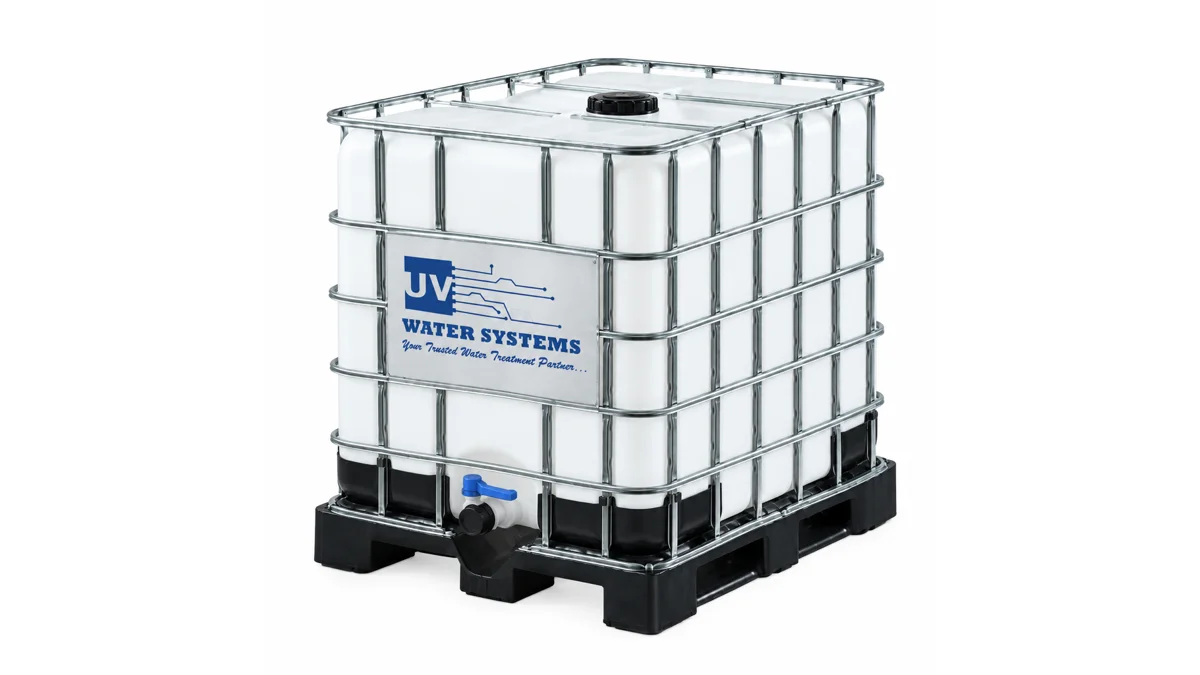
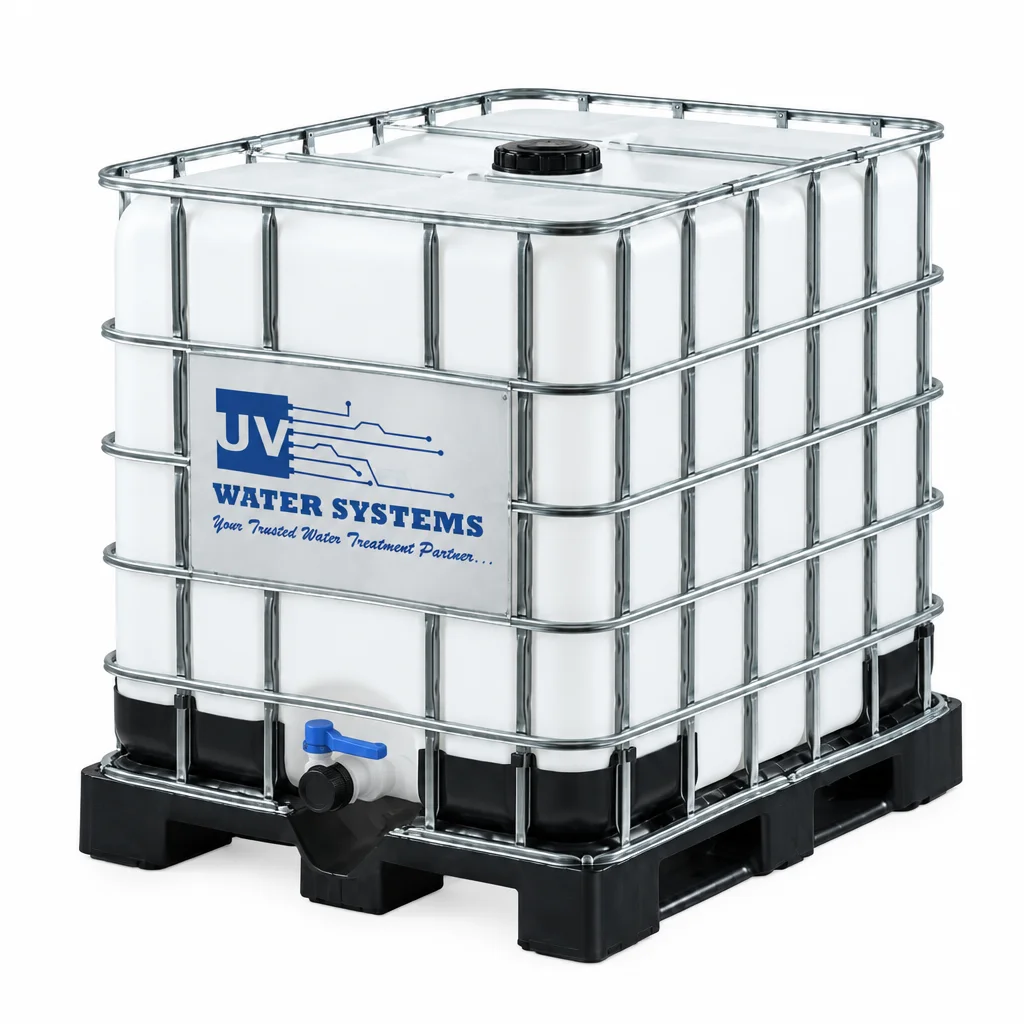
| IBC tote | 1,000 litres | 130 OMR per IBC (130 baisa per litre) | Factories, warehouses, hotels, battery rooms |
| Tanker | Bulk loads | Quoted per litre | Ships, power plants, construction and commissioning |

What drives the price of DM water in Oman
- Purity grade: water below 1 µS/cm needs more resin capacity and more frequent regeneration than water below 5 µS/cm.
- Container: one 1,000-litre IBC costs far less per litre than fifty 20-litre cans.
- Delivery distance: Muscat deliveries cost less than runs to Duqm, Sur or Salalah.
- Monthly volume: a fixed monthly schedule earns contract pricing.
- Documentation: batch test reports for audits and boiler logs.
When you compare quotes for DM water supply in Oman, compare the conductivity limit, container, delivery and test report on the same basis. A cheaper quote with no conductivity figure is not the same product.
How to check a DM water delivery
- Seal: the cap seal should be intact and the container clean, with no old labels from other chemicals.
- Batch label: check the production date, batch number and conductivity reading.
- Conductivity: test a sample with a handheld meter. A reading of 1 to 3 µS/cm after opening is normal, because pure water picks up CO₂ from air within minutes.
- Appearance: the water should be clear, with no colour, smell or floating particles.
- Paperwork: the test report, if you asked for one, should carry the same batch number as the label.
We stock handheld TDS and conductivity meters in our instrumentation range.
Storing DM water in Omani heat
- Keep the IBC or drum in shade. Summer sun in Oman ages HDPE and warms the water.
- Keep the cap closed between draws. Open DM water absorbs CO₂ and its conductivity rises.
- Use a clean, dedicated hose or pump. Never top up a demineralised water container with tap water.
- Do not decant DM water into used chemical drums or old drinking water bottles.
- Use an opened container within a few weeks for lab and battery work.
Common problems when sites skip DM water
Most of the call-outs we attend that involve pure water trace back to one decision: using whatever water was nearest. These are the four patterns we see most often in Oman.
Battery rooms topped up from the tap
A warehouse tops up its forklift batteries from a hose. Within a year the cells show white sulphate and brown iron staining, run times drop, and the batteries are replaced early. The cost of one replacement battery set pays for years of DM water in Oman at IBC prices.
Boiler scale from “RO water” make-up
RO water is a good start, but at 20 to 60 µS/cm it still carries hardness and silica into a steam generator. Over months the heating surfaces scale up, fuel use climbs and the safety valve or level probes start giving trouble. Switching the make-up to demineralised water, or adding a mixed-bed polisher after the RO, stops the build-up.
Solar panels washed with tanker water
Washing a rooftop PV array with well or tanker water leaves a dry mineral film that the next dust storm sticks to. Operators then wash more often and still lose output. A DM water final rinse, even after a normal wash, leaves the glass clean when it dries in the sun.
Standby generators overheating in summer
A standby generator that has been topped up with tap water for years overheats on its first long run in July. The radiator core is lined with scale. Flushing and refilling with coolant mixed in demineralised water solves it, and keeps it solved.
8 questions to ask before you sign a DM water supply contract
- What conductivity do you guarantee at filling? Get a number in µS/cm, not the word “pure”.
- How is the water produced? RO followed by mixed-bed deionisation is the normal route for DM water supply in Oman.
- Is every batch tested, and is the reading on the label?
- Can you issue a test report for each delivery? Auditors and boiler inspectors will ask for it.
- What container is used, and was it used for anything else before?
- What is the lead time, and who unloads? A full IBC weighs about a tonne and needs a forklift or pallet jack.
- What does the price include? Compare water, container, delivery and documents on the same basis.
- What happens if a batch fails our check? A serious supplier replaces it.
We answer all eight in writing on every DM water supply in Oman quotation we send, so your purchasing team can compare offers line by line.
IBC supply or an on-site DM plant?
Buying DM water by the IBC makes sense while your use is measured in hundreds of litres a week. At ten IBCs a month you are spending 1,300 OMR a month, or 15,600 OMR a year, on water alone, plus the handling. At that level an on-site plant is worth pricing.
Options we supply and service include the 1 m³/hour two-bed DM plant, the 5 m³/hour DM plant, the Aquapro mixed bed DI filter for small RO outlets, and a 500 LPH EDI module for chemical-free polishing. Send us your monthly volume and purity limit and we will compare both routes on paper.
Why choose UV Water Systems for DM water supply in Oman
- Own production: our RO and deionisation line runs in Muscat, so we control the water from feed to filling.
- Batch testing: conductivity is measured on every batch, and a test report is available on request.
- 14+ years in Oman and ISO 9001:2015 certified.
- Engineering support: the same team designs and services DM plants for hospitals, oil and gas sites, hotels and factories.
- One supplier for every size: from a 20-litre can to tanker loads, or a plant when the numbers favour it.
DM water terms in plain English
- µS/cm (microsiemens per centimetre): the unit for conductivity. Lower means purer. DM water is usually below 2 µS/cm.
- MΩ·cm (megohm centimetre): resistivity, the inverse of conductivity, used for ultrapure lab water. 18.2 MΩ·cm is the theoretical maximum for pure water at 25 °C.
- TDS (total dissolved solids): the weight of dissolved salts, in ppm or mg/L. A handheld TDS pen is fine for tap and RO water but too coarse for DM water, so use a conductivity meter instead.
- Two-bed DM plant: a cation resin column followed by an anion resin column. It produces DM water at a few µS/cm and is regenerated with acid and caustic.
- Mixed-bed polisher: cation and anion resin in one vessel. It takes RO or two-bed water down to below 1 µS/cm.
- EDI (electrodeionisation): a membrane stack that polishes RO water with electricity instead of chemical regeneration.
- IBC (intermediate bulk container): the 1,000-litre caged tote on a pallet base used for most DM water deliveries in Oman.
FAQs about DM water supply in Oman
How much does DM water cost in Oman?
Our 1,000-litre DM water IBC costs 130 OMR, which is 130 baisa per litre. Smaller packs and tanker loads are quoted on request.
Is DM water safe to drink?
DM water is produced for technical use and is not sold as drinking water. It has no minerals. For drinking, use RO water with minerals added back.
Can I use DM water instead of distilled water in batteries?
Yes. For flooded lead-acid batteries, DM water below 5 µS/cm does the same job as distilled water. Sealed AGM, gel and VRLA batteries are not topped up at all.
Why does the conductivity reading rise after I open the IBC?
Pure water absorbs carbon dioxide from air, which forms a trace of carbonic acid. The reading rises slightly and the pH drops to around 5.5 to 6. This is normal and does not mean the water is contaminated.
Do you deliver DM water outside Muscat?
Yes. Sohar, Nizwa, Sur, Duqm and other areas are quoted with a delivery charge based on distance and the number of IBCs.
Can I get a test certificate with my order?
Yes. Every batch is conductivity-tested at filling and we issue a water test report on request, which you can file with boiler logs, lab QA records or audit packs.
How long does DM water keep in a sealed IBC?
Sealed and stored in shade, the water stays usable for battery, cooling and rinsing work for several months. For lab work where the conductivity limit is tight, plan to use it within a few weeks of delivery and test before each use.
Is the “battery water” sold in shops the same as DM water?
Sometimes. Some retail battery water is DM water and some is lightly filtered tap water. Without a conductivity figure on the label there is no way to know. Test it with a meter, or buy from a supplier who prints the reading on every batch.
Order DM water in Oman
To arrange DM water supply in Oman, call or WhatsApp +968 9763 7786 or email sales@waterfilteroman.com with the volume, site location and the conductivity limit you need. You can also order a DM water IBC online. هذا الدليل متوفر أيضًا باللغة العربية.