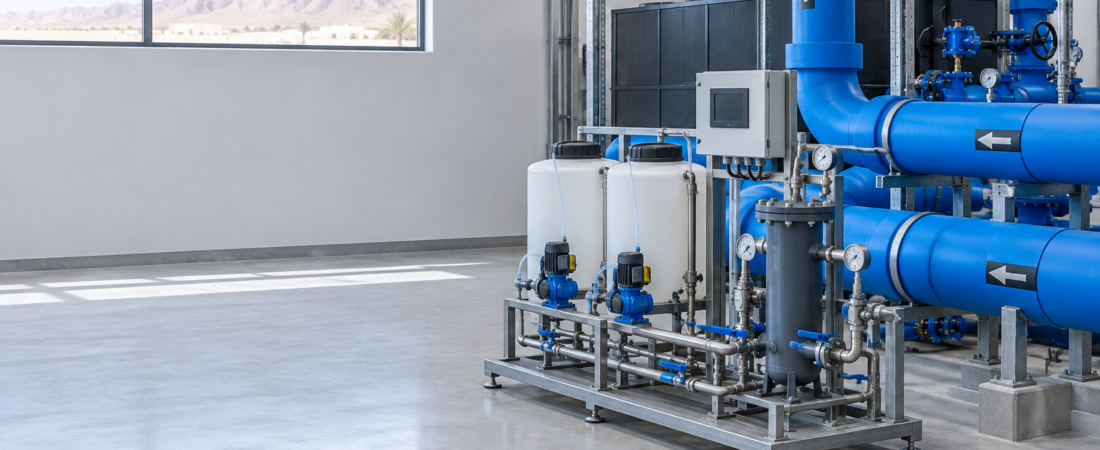
Chilled water treatment in Oman is the part of HVAC maintenance most buildings forget until a chiller tube leaks or fan coil valves seize. A closed chilled water loop looks sealed, so owners assume the water inside stays clean. It does not. Oxygen, bacteria and construction debris get in, and in a climate where chillers run almost all year, corrosion moves fast.
This guide explains how chilled water treatment in Oman works, the test limits we work to, and the seven mistakes that cost building owners chillers, pumps and pipework.
What this guide covers
- How a closed chilled water loop fails
- Chilled water treatment in Oman: the inhibitor programme
- Control limits we test against
- Side-stream filtration and dosing equipment
- 7 costly mistakes to avoid
- Planning chilled water treatment in Oman for a new building
- Who is responsible for chilled water treatment in Oman
- Monthly service checklist
- Chilled water treatment in Oman: FAQ
How a closed chilled water loop fails
A chilled water system circulates water at around 6 to 7 °C from the chiller to air handling units and fan coil units, and brings it back at 12 to 13 °C. Hotels, hospitals, malls, office towers and new residential towers in Muscat use this design, and so do the district cooling plants that serve whole developments. The loop is closed, so in theory the same water circulates for years. Three things break that theory.
Oxygen ingress
Every top-up of make-up water, every section drained for maintenance, and every expansion vessel or pressurisation unit set at the wrong pressure lets dissolved oxygen in. Oxygen plus untreated carbon steel gives rust. The black and red sludge you find in a strainer is iron oxide that used to be your pipe wall.
Bacteria
Closed loops in Oman run at temperatures bacteria like, especially on the return side and in dead legs. Sulphate-reducing bacteria and other biofilm formers cause microbially influenced corrosion (MIC): deep pinholes under slime that can perforate pipe within a few years. Nitrite-based inhibitors also feed nitrifying bacteria, which is why the nitrite level can fall with no water loss at all.
Debris and fouling
Mill scale, welding slag, sand and jointing compound left in new pipework block strainers, coat heat exchanger tubes and jam two-port control valves. Later in the system’s life, iron oxide sludge does the same. Fouled evaporator tubes make the chiller work harder for the same cooling, and you pay for that every month on the electricity bill.
Chilled water treatment in Oman: the inhibitor programme
Good chilled water treatment in Oman rests on four parts: a corrosion inhibitor, a biocide programme, filtration and regular testing. The chemistry has to suit the metals in your loop. Most systems here combine carbon steel pipe, copper or cupronickel in chiller tubes and coils, brass valves, and sometimes stainless steel or aluminium.
- Nitrite-based inhibitors protect steel well and are the most common closed-loop treatment. They need regular testing because bacteria consume nitrite.
- Molybdate-based inhibitors resist bacterial breakdown better and are often blended with nitrite for mixed-metal systems.
- Azoles (TTA or BTA) protect copper and brass. Without them, dissolved copper plates out on steel and causes galvanic pitting.
- Non-oxidising biocides such as isothiazolinone or glutaraldehyde are dosed on a schedule or when bacteria counts rise. Rotating two biocides stops the population adapting.
- pH buffers hold the loop in the alkaline range where steel corrodes slowest.
Many consultants in Oman also specify electronic anti-scale units such as the Vulcan electronic anti-scale system on chilled water lines. These can reduce scale where make-up water is hard, but they do not stop oxygen corrosion or bacteria. Treat them as an addition to an inhibitor programme, never a replacement for it.
Control limits we test against
The exact ranges come from the chemical programme and the system metallurgy. The table shows the typical targets UV Water Systems works to for chilled water treatment in Oman on steel and copper loops.
| Parameter | Typical target | What a bad result tells you |
|---|---|---|
| pH | 8.5 to 9.5 | Low pH speeds steel corrosion; very high pH attacks aluminium and copper |
| Nitrite (as NO2) | 500 to 1,000 mg/l on nitrite programmes | Falling with no water loss points to bacterial activity |
| Molybdate (as MoO4) | 100 to 200 mg/l on molybdate programmes | A steady fall means make-up water is diluting the loop |
| Total iron | Below 1.0 mg/l | A rising trend means active corrosion somewhere in the loop |
| Copper | Below 0.2 mg/l | Copper is going into solution; check the azole level |
| Aerobic bacteria (TVC) | Below 10,000 cfu/ml | Biofilm is building; a biocide dose is due |
| Pseudomonas | Below 1,000 cfu/ml | Slime formers present; coils and strainers will foul |
| Sulphate-reducing bacteria | Not detected | Pinhole pitting risk; check dead legs and dose biocide |
| Make-up water | Below 5% of system volume per year | Higher means a leak, a passing relief valve or an open drain |
These targets follow the approach in BSRIA’s BG 50 guide to water treatment for closed heating and cooling systems, which consultants on Oman projects often reference in their specifications.
Side-stream filtration and dosing equipment
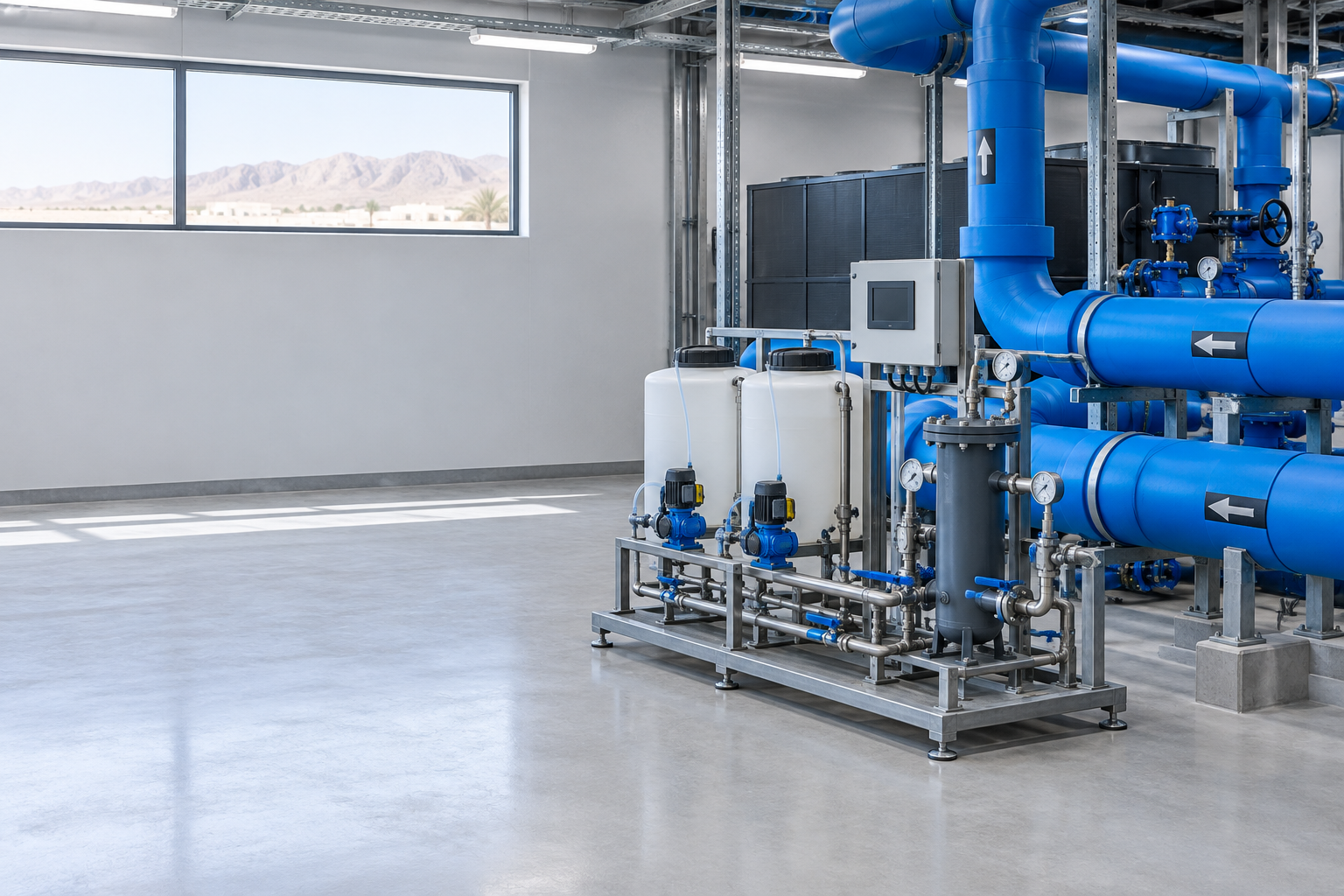
Chemistry alone does not complete chilled water treatment in Oman. Iron oxide particles keep circulating, settle where velocity is low, and shelter bacteria underneath. A side-stream filter takes a small share of the circulating flow, usually around 5 percent, through 5 to 25 micron bag or cartridge filters and returns it clean. On large loops, a magnetic filter catches the fine magnetite that bag filters miss.
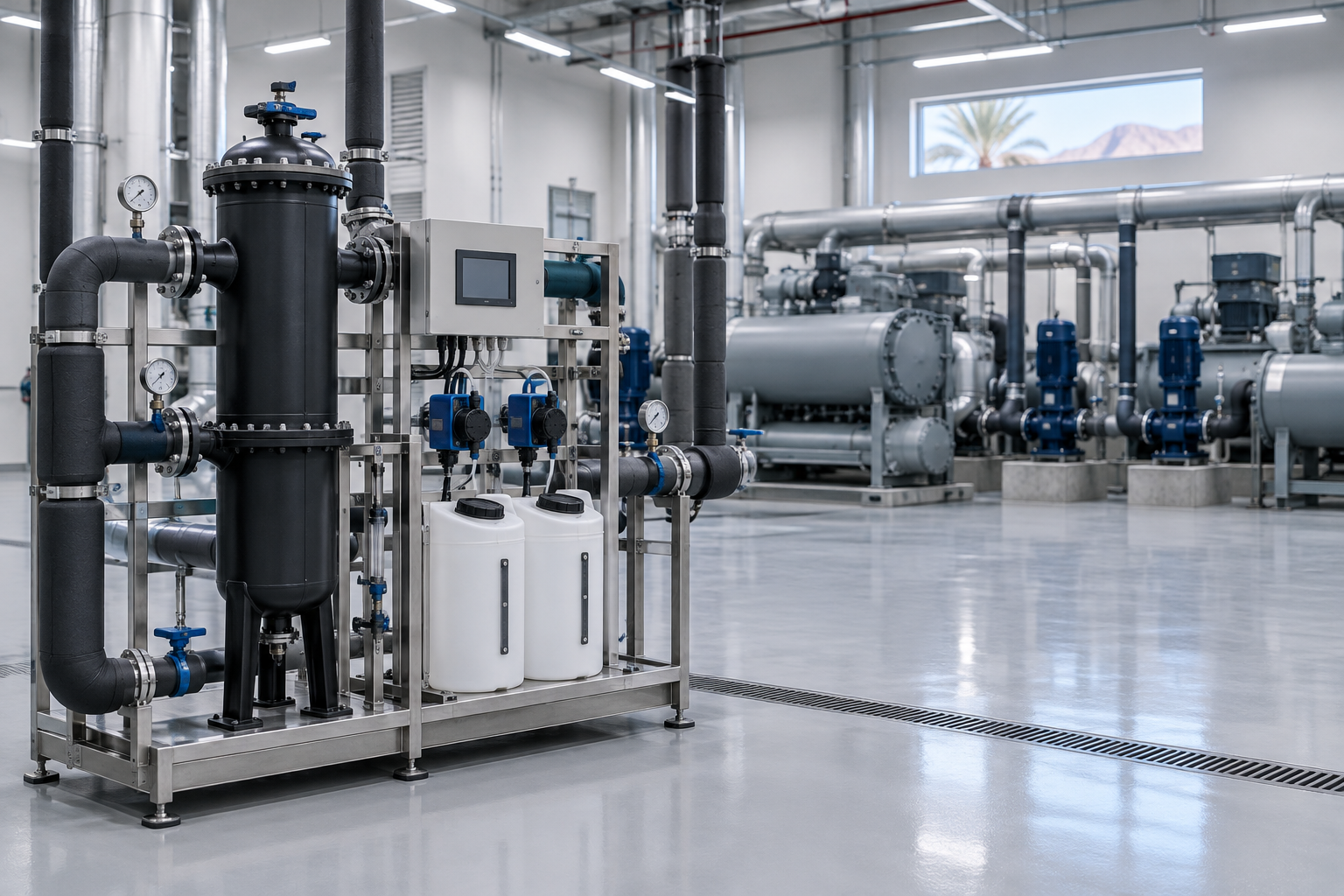
Small and medium systems are dosed through a pot feeder (shot feeder): a pressure vessel piped across flow and return, which the technician fills with inhibitor and opens to the loop. Larger systems and district cooling plants use automatic dosing. A pump such as the Emec dosing pump is paced from a pulse water meter on the make-up line, so every litre of fresh water gets its share of inhibitor. That ends the dilution problem on systems that lose water.

A typical package we supply for chilled water treatment in Oman includes:
- Pot feeder, or an automatic dosing skid with Emec pump, day tank and injection assembly
- Pulse-output water meter on the make-up line
- Side-stream bag or cartridge filter with isolation valves and pressure gauges
- Corrosion coupon rack with steel and copper coupons, so corrosion rates are measured, not guessed
- A sampling point and a monthly test and service visit
7 costly mistakes to avoid
Most of the failed loops we are called to share the same causes. Avoid these seven and chilled water treatment in Oman becomes a routine monthly job rather than an emergency.
1. Filling a new system with untreated water and leaving it
On many projects the pressure test happens months before handover. Water sits in new steel pipe at plant room temperatures above 30 °C with no inhibitor and no circulation. Bacteria colonise and pitting starts before the building opens. Dose inhibitor and biocide at fill, or drain and dry the system after testing.
2. Skipping pre-commission flushing
Weld slag, sand and mill scale left in pipework end up in fan coil valves and chiller tubes. A proper flush and chemical clean before handover costs far less than replacing seized valves across 200 apartments.
3. Using tanker or well water for make-up
Brackish well water in Oman can carry chloride above 1,000 mg/l. Chloride and sulphate attack steel and break down inhibitor films. Use municipal supply at minimum, and softened or RO water where the loop is large or losses are high. Our water softener guide covers sizing.
4. Ignoring make-up water volume
A closed loop should need very little water. If the make-up meter shows steady consumption, there is a leak, a passing relief valve or a drain left open. Every litre of fresh water brings oxygen and dilutes the inhibitor. Fix the leak before raising the chemical dose.
5. Testing only nitrite and pH
Nitrite and pH can look fine while sulphate-reducing bacteria pit the pipe. Send samples for microbiological testing at least quarterly and check total iron every month. The trend matters more than any single result.
6. Dosing biocide without filtration
Biocide kills bacteria in the bulk water, but biofilm under iron sludge stays protected. Without side-stream filtration, the sludge returns and the bacteria with it. Clean the strainers, run the filter, then dose.
7. Letting dead legs stagnate
Unoccupied floors, valves closed to future tenancy areas and standby pumps create pockets where water never moves. That is where MIC starts. Circulate them weekly or include them in the biocide programme.
If your building also has open cooling towers on the condenser side, those need a separate programme. See our cooling tower scale treatment guide, the cooling tower water treatment service and our Legionella control checklist.
Planning chilled water treatment in Oman for a new building
New towers with central chilled water systems are handed over every year in Muscat, Seeb and Sultan Haitham City. The cheapest time to get chilled water treatment in Oman right is before the first fill. BSRIA’s guide on pre-commission cleaning of pipework systems (BG 29) sets out the sequence most consultants specify:
- Flush each section at velocity to remove loose debris, with strainers fitted and terminal units bypassed.
- Chemically clean with a dispersant to strip mill scale, oil and flux.
- Flush again until turbidity, iron and conductivity in the loop match the fill water within agreed limits.
- Dose inhibitor and biocide straight away, then test and record the baseline.
- Install the side-stream filter, dosing point and coupon rack before handover, not after.
Ask for the flushing records and the first water analysis as part of the handover file. A facility manager who inherits a building without them is guessing.
Who is responsible for chilled water treatment in Oman
Responsibility usually splits three ways, and the gaps between them are where systems fail:
- MEP contractor: flushing, cleaning and the first chemical fill before handover.
- Consultant: specifying the treatment programme, dosing equipment and test limits in the tender documents.
- Facility manager or owner: monthly testing, chemical top-ups, filter changes and acting on bad results after handover.
A specialist should sit alongside all three. UV Water Systems supplies dosing equipment, chemicals and monthly service for chilled water treatment in Oman, so one team owns the results from commissioning onward. Read how to choose a water treatment company in Oman before you appoint one. For steam and hot water plant, see our boiler feed water treatment guide.
Monthly service checklist
Every chilled water treatment in Oman contract we run follows the same monthly visit:
- Read the make-up water meter and compare with last month
- Test pH, conductivity, nitrite or molybdate, and total iron on site
- Check the azole level where copper is present
- Inspect and change side-stream filter bags or cartridges, and record differential pressure
- Top up inhibitor to target through the pot feeder or day tank
- Check dosing pump stroke, injection point and day tank level
- Every quarter: send samples for TVC, Pseudomonas and SRB, and pull corrosion coupons for weighing
- Issue a service report with results, trends and actions
Chilled water treatment in Oman: FAQ
How often should a chilled water system be tested?
For chilled water treatment in Oman, monthly on-site chemistry and quarterly microbiology suit most buildings. New systems and loops with known problems need closer monitoring for the first six months.
What does chilled water treatment in Oman cost?
It depends on system volume, metallurgy and how much make-up water the loop uses. A pot feeder programme for a mid-size building costs far less than automatic dosing for a district cooling plant. Send us the system volume, chiller tonnage and a recent water analysis and we will price it.
Can I use RO water in a chilled water loop?
RO or softened water makes good fill and make-up water because it is low in chloride and hardness. It still needs inhibitor, because pure water with oxygen corrodes steel.
Why is my chilled water black?
Black water usually means suspended magnetite from corrosion. Check total iron, inhibitor level and make-up water use, and fit side-stream or magnetic filtration.
Do closed chilled water systems carry a Legionella risk?
Closed loops run cold and sealed, so the risk is low. Legionella risk sits in open cooling towers, hot water systems and storage tanks, which need their own control plan.
Do you supply Emec dosing pumps for chilled water systems?
Yes. UV Water Systems supplies and installs Emec dosing pumps, pot feeders, side-stream filters, coupon racks and chemicals, and runs the monthly service programme.
Get a treatment programme for your building
Send us the building name, chiller capacity, system volume if known, and any recent test report. We will test the loop on site and recommend the chilled water treatment in Oman that fits your system, from a pot feeder programme to full automatic dosing.
Call or WhatsApp: +968 9763 7786
Email: sales@waterfilteroman.com
This guide is also available in Arabic.