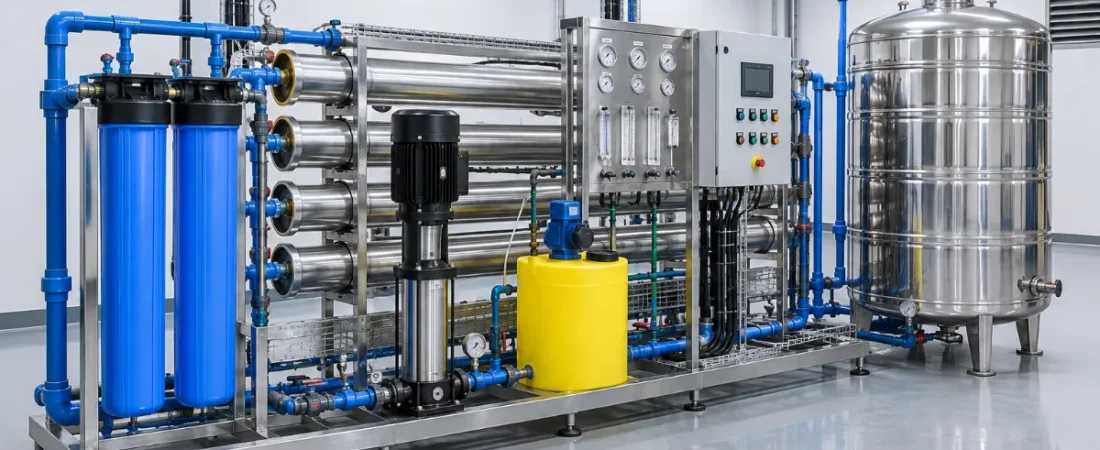
RO membrane cleaning in Oman is the job most plants leave too late. Operators raise feed pressure to hold output, the differential pressure climbs for another month, and by the time the cleaning is ordered the deposit has set hard and the membranes never recover their original flux. This guide sets out when to clean, which chemical matches which deposit, the full clean-in-place sequence, and the mistakes that destroy elements during RO membrane cleaning in Oman.
What this guide covers
- The three triggers that say clean now
- Identify the foulant before you buy the chemical
- Chemicals we supply in Muscat
- The clean-in-place sequence
- 6 mistakes that destroy membranes
- Biocide and microbiological control
- Who is responsible on site
- FAQ
The three triggers that say clean now
Membrane manufacturers agree on the thresholds. Clean when any one of these moves 15 percent from the commissioning baseline, corrected for temperature, pressure and feed salinity:
- Normalised permeate flow down 10 to 15 percent. The earliest and most reliable signal.
- Differential pressure across a stage up 15 percent. Points to particulate, biological or colloidal fouling in the feed channels.
- Normalised salt passage up 10 to 15 percent. Usually scale on the tail elements, or oxidation damage if it rises without a pressure change.
Waiting until flow has dropped 30 percent is the difference between a recoverable clean and a membrane replacement. This is why daily logs matter more than any chemical on the shelf: without normalised data you cannot see any of the three triggers.
Identify the foulant before you buy the chemical
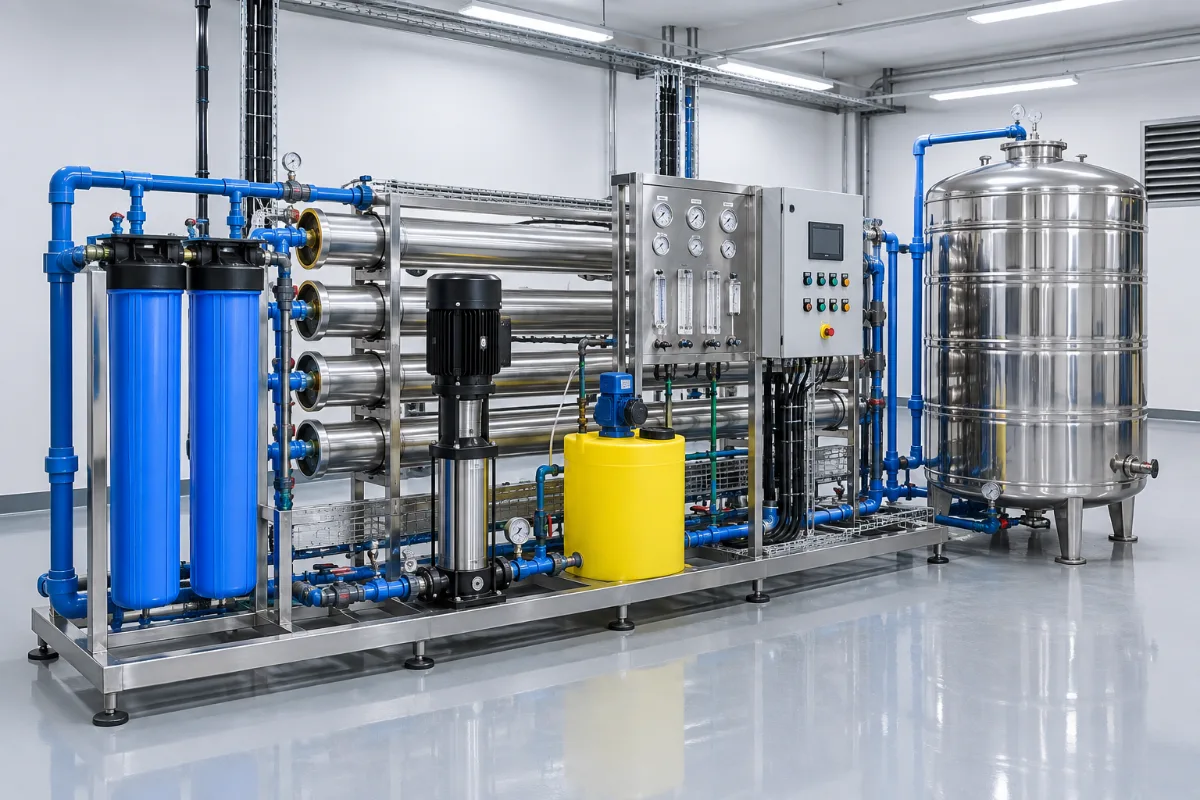
Using an acid cleaner on biofilm, or an alkaline cleaner on carbonate scale, wastes the clean and can set the deposit harder. Work from evidence:
| Symptom pattern | Likely foulant | Cleaner type |
|---|---|---|
| Salt passage up, flow down, last stage worst | Calcium carbonate or sulphate scale | Low pH acid cleaner |
| Differential pressure up sharply, first stage worst | Biofilm, organics, colloidal silt | High pH alkaline cleaner |
| Red or brown deposit on the lead element | Iron or manganese | Low pH cleaner with reducing agent |
| Flow loss resistant to both, gradual over months | Silica | High pH cleaner, extended soak |
Where the plant history is unclear, autopsy one element or send a swab for analysis. A 25 kg container of the wrong cleaner is cheap; a membrane bank is not. DuPont FilmTec cleaning procedures give the pH and temperature limits each element can tolerate, and exceeding them voids the membrane warranty.
Chemicals we supply for RO membrane cleaning in Oman
UV Water Systems stocks these in 25 kg containers in Muscat:
| Product | SKU | Role |
|---|---|---|
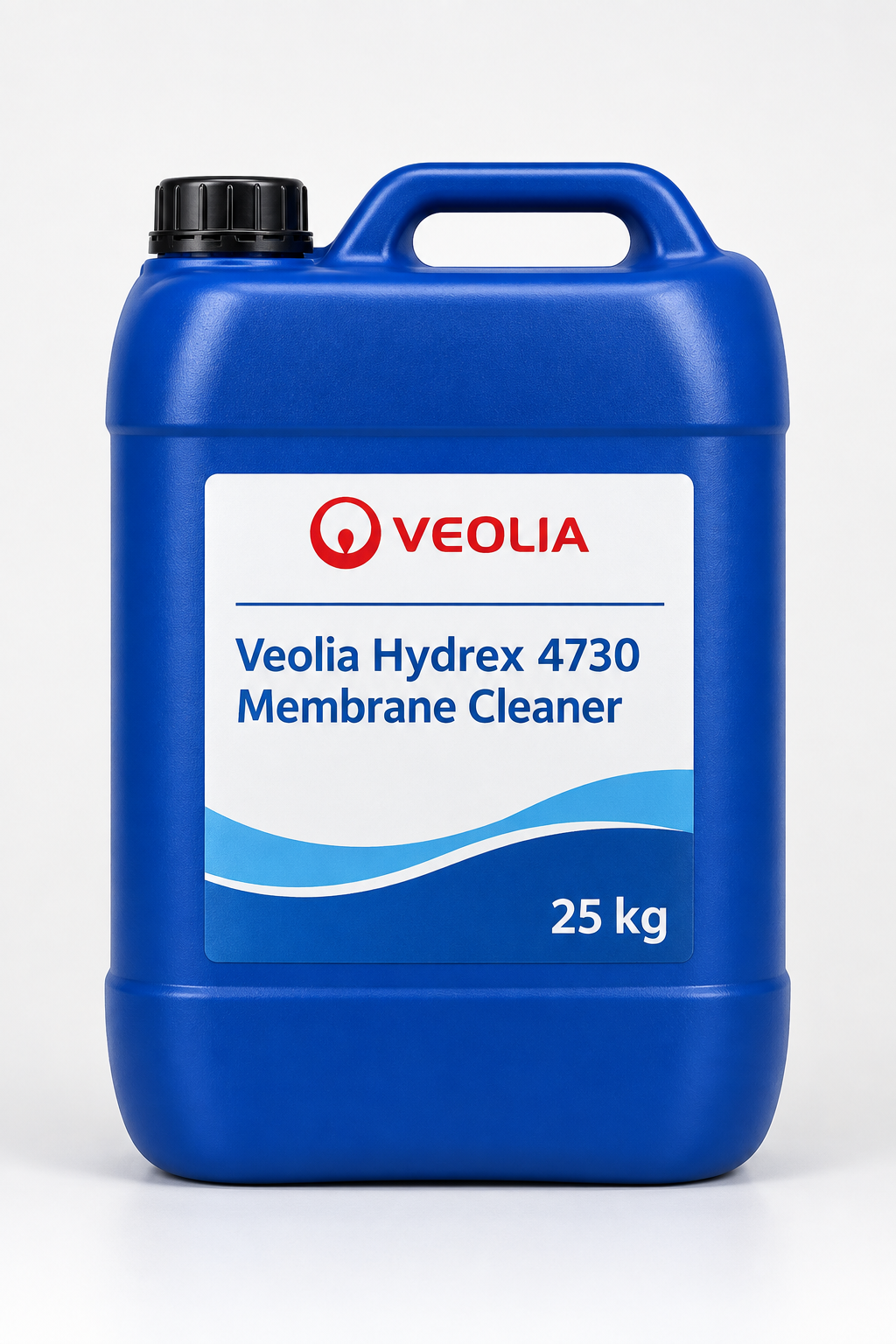
| Veolia Hydrex 4730 Membrane Cleaner | UVS-HYD4730-25KG | Formulated membrane cleaner, selected on the deposit analysis |
| Veolia Hydrex 4731 Membrane Cleaner | UVS-HYD4731-25KG | Companion cleaner for the opposite deposit group, used in a two-stage clean |
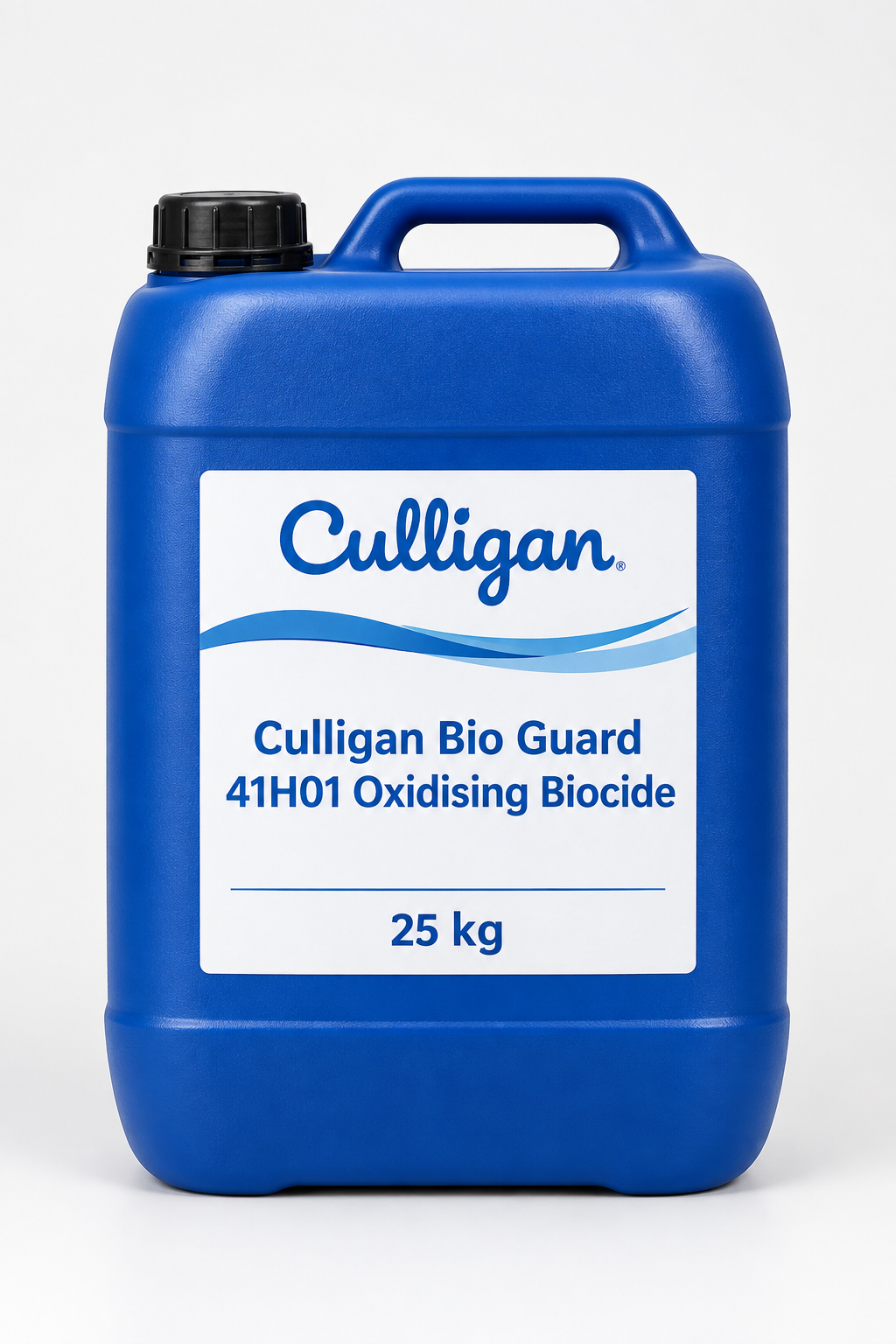
| Culligan Bio Guard 41H01 Oxidising Biocide | UVS-BG41H01-25KG | Microbiological control in compatible systems and on non-membrane circuits |
The 4730 and 4731 pair is used together on plants that need both an acid and an alkaline stage. Which product leads depends on the foulant: scale-first plants run the low pH stage first, biofouled plants run the high pH stage first. We confirm the chemistry, concentration, pH window and temperature limit against your element make and model before any clean.
RO membrane cleaning in Oman: the clean-in-place sequence
- Flush with permeate. Displace the feed water with permeate or good quality product water at low pressure. Never start a clean on raw feed.
- Make up the solution. Use permeate, not raw water, at the concentration on the data sheet. Check the pH after mixing and adjust inside the element limit, typically pH 2 to 11 depending on the membrane.
- Heat if permitted. Cleaning works faster warm, but most elements cap out at 35 to 45 °C. In Oman ambient often supplies this on its own; do not exceed the limit chasing speed.
- Low-flow circulation. Circulate at low pressure so the solution flows through the feed channels without pushing the foulant into the membrane. Discard the first return to drain while it is dirty.
- Soak. Stop and soak for 30 to 60 minutes, longer for hardened deposits. Recirculate briefly every 20 minutes to keep the solution moving.
- High-flow rinse. Raise flow to the maximum the element permits to carry the loosened deposit out of the channels.
- Flush and second stage. Flush to a neutral pH, then run the second cleaning stage if the deposit analysis calls for it.
- Return to service and record. Run to drain until permeate conductivity and taste are acceptable, then log the normalised flow, differential pressure and salt passage. That number becomes your new baseline.
Clean each stage separately where the plant has more than one, so the foulant from stage one is not driven into stage two.
6 mistakes that destroy membranes
- Mixing acid and alkaline cleaners, or running them back to back without a flush. Flush to neutral between stages, every time.
- Cleaning with raw feed water. Hardness in the make-up water precipitates with the cleaner and adds a new deposit.
- High pressure during circulation. Pressure compacts the foulant into the membrane surface. Clean at low pressure, high flow.
- Exceeding the pH or temperature limit. It hydrolyses the polyamide layer. The damage shows as permanently high salt passage and it is not reversible.
- Using chlorine or any free-chlorine biocide on polyamide membranes. Oxidation ruins the rejection layer within hours. Oxidising biocides belong on compatible circuits, not inside an RO.
- No post-clean record. If you do not log the result you cannot tell a successful clean from a fouling cycle that is accelerating.
Biocide and microbiological control
Biological fouling is the most common cause of rising differential pressure on Omani plants that sit idle over weekends or run on stored water. Control is a programme, not a single dose: keep stored feed water turning over, clean the break tanks, keep the cartridge filters on schedule, and use an approved biocide on the circuits that tolerate it. Culligan Bio Guard 41H01 is an oxidising biocide for compatible systems and must never be dosed into a polyamide RO feed. Where the plant will stand idle more than 48 hours, preserve the elements in an approved storage solution instead. For the related building-side risk see our guide to Legionella control in Oman, and the WHO drinking-water quality guidelines for finished water limits.
Who is responsible for RO membrane cleaning on site
- Plant owner or facility team approves the shutdown window, keeps cleaning chemicals in stock, and provides drain and power for the CIP skid.
- Operator records flow, pressure and conductivity daily so the cleaning trigger is visible, and reports a 10 percent change rather than waiting for a failure.
- Water treatment contractor normalises the data, identifies the foulant, selects the chemical and concentration against the element datasheet, runs the clean, and reports the before and after figures.
Service visit checklist: normalised flow, differential pressure and salt passage plotted against baseline, cartridge filter differential recorded, CIP tank cleaned, cleaning solution pH and temperature logged during circulation, each stage cleaned separately, post-clean flush to neutral confirmed, new baseline recorded, safety data sheets on site, used solution neutralised before discharge.
FAQ
How often should an RO plant be cleaned?
By condition, not by calendar. A well-run plant on good pretreatment may go 6 to 12 months. More than four cleans a year means the pretreatment or the antiscalant programme needs fixing, not more cleaning.
Can I clean the membranes myself?
A trained operator with a CIP skid and the correct chemical can. The failure modes are pH, temperature and pressure, and all three are easy to get wrong. For a first clean we recommend doing it with our technician present.
Will cleaning restore the original output?
Usually most of it, if the clean happens at the 10 to 15 percent trigger. Cleaning after a 30 percent loss typically leaves a permanent deficit.
What stops the fouling coming back?
Correct pretreatment and a projected antiscalant dose. See our guide to RO antiscalant in Oman.
Book a membrane clean or order the chemical
Our full scope, the CIP-1 to CIP-4 packages and coverage areas are on the RO membrane cleaning and CIP service in Oman page.
Send your plant details and the last three months of operating logs to UV Water Systems in Muscat. We will identify the foulant, quote the cleaning chemical and the clean-in-place service, and set the trigger thresholds for your plant. Call +968 9763 7786 or email sales@waterfilteroman.com.