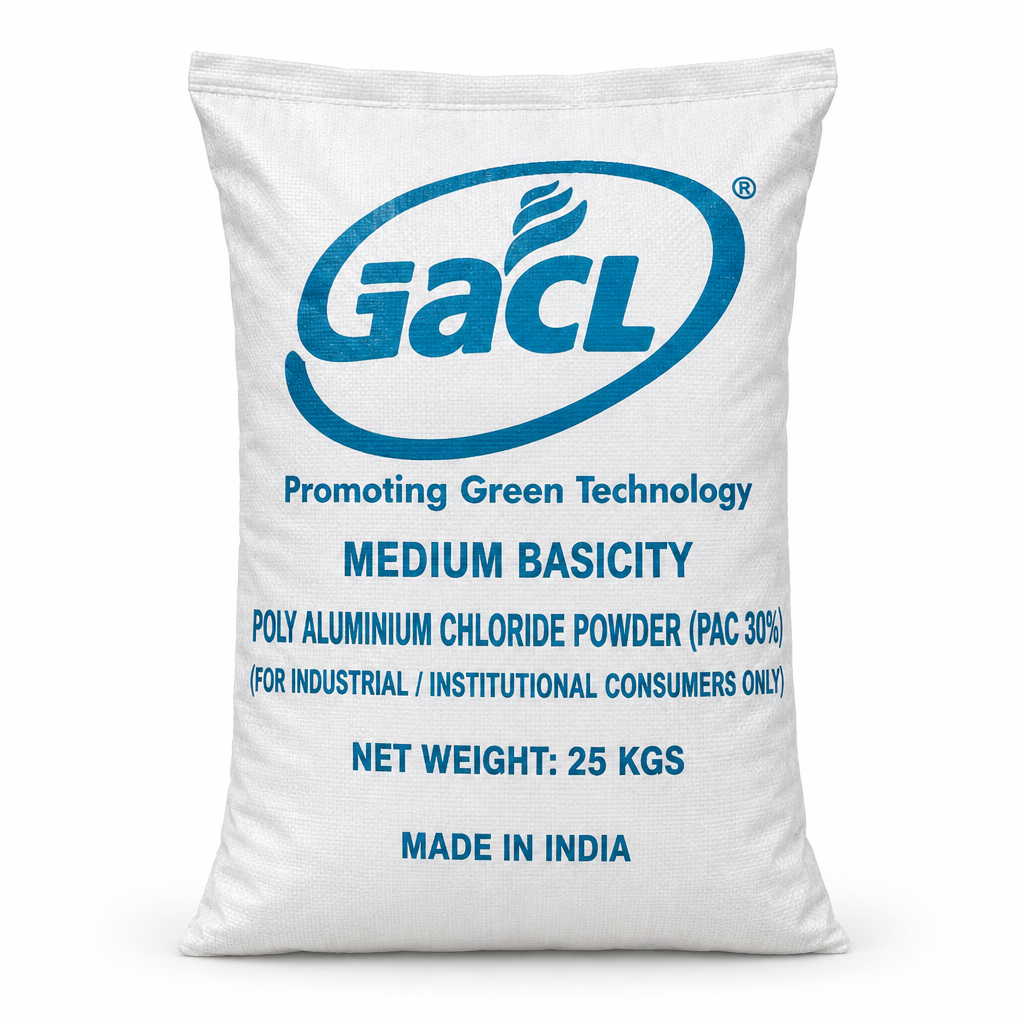
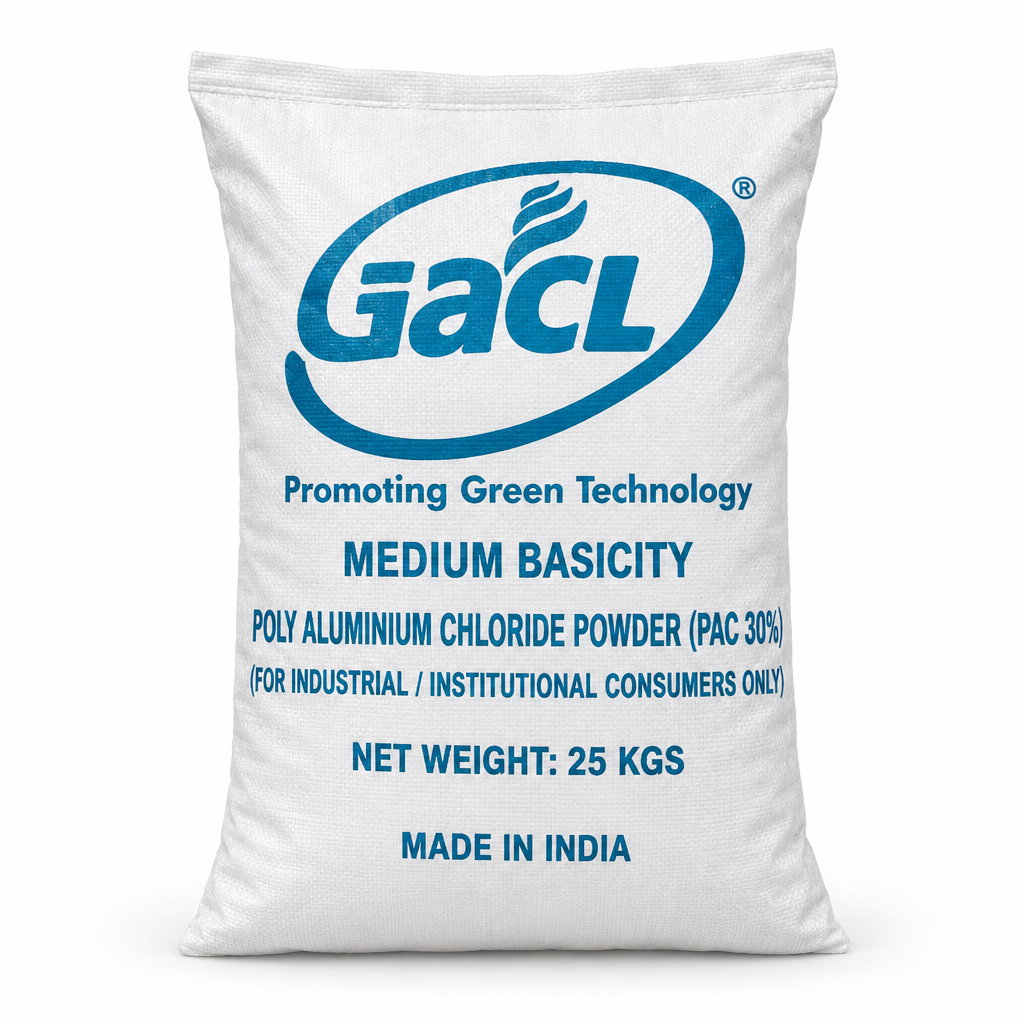
Looking for PAC powder Oman Muscat for a raw-water clarification project? Polyaluminium chloride, commonly called PAC, is a coagulant that helps treatment systems separate fine suspended particles from water. UV Water Systems lists this product in a 25 kg bag, making it an option for commercial and industrial treatment operations in Oman.
PAC works as part of a treatment process. Successful results depend on the source water, chemical selection, mixing, separation and filtration. This guide explains seven practical points to consider before ordering and operating a PAC dosing system.
Contents
- Understand what PAC does
- Match PAC to the water source
- Confirm the chemical specification
- Establish the dose through jar testing
- Integrate dosing with filtration
- Monitor performance and storage
- Request the right supply and support
1. What does PAC powder do?
Very fine particles can remain dispersed in water instead of settling naturally. During coagulation, a suitable chemical helps destabilise these particles. Controlled flocculation then encourages them to join into larger aggregates, known as flocs, which can be removed by an appropriate separation and filtration process.
This makes PAC relevant where suspended solids and turbidity are treatment concerns. However, clearer water alone does not prove that water meets drinking-water requirements. PAC is not a replacement for disinfection, and it does not perform the dissolved-salt removal function of reverse osmosis.
2. Match PAC powder Oman Muscat to your application
Potential applications include raw-water clarification, industrial process-water pretreatment and suitable wastewater treatment processes. The correct choice depends on the actual water analysis and the required treated-water quality.
For example, a facility receiving water with changing suspended solids may need to review its coagulation settings when the source changes. A dose that worked on an earlier sample may not give the same result after a change in turbidity, pH or alkalinity. Design the operating procedure around measured conditions rather than appearance alone.
3. PAC powder Oman Muscat: confirm the specification
The PAC powder product listing identifies a 25 kg bag and lists an aluminium oxide content of 28–30%. Before placing an order, confirm the current technical data sheet, safety data sheet and batch specification for the material being supplied.
Where potable-water treatment is intended, verify that the specific chemical grade and its documentation meet the project’s requirements. A company’s quality-management certification should not be treated as proof that every chemical grade is suitable for every application. Confirm packaging condition, quantity and storage arrangements as part of procurement.
4. Use jar testing to establish the dose
A jar test compares treatment results from the same water sample at different coagulant doses. It helps operators assess floc formation, settling and clarified-water quality before transferring a setting to the full-scale process.
Keep the testing conditions consistent and record the dose, pH, sample source and observed results. Select a practical operating condition based on treatment quality and plant constraints. Repeat testing when feed-water conditions change significantly. The highest chemical dose is not automatically the best choice, and excessive dosing can create operational problems.
5. Connect dosing to the complete filtration process
PAC treatment needs suitable chemical preparation, controlled dosing, effective initial mixing and a downstream process capable of removing the resulting solids. The arrangement may include flocculation and settling before filtration, or another engineered configuration appropriate to the application.
Review dosing-pump capacity, flow variation, contact conditions, filter loading and sludge handling together. Installing a chemical pump alone does not establish an effective coagulation system. In RO pretreatment, assess the consequences of chemical carryover and confirm compatibility with the membrane system’s requirements.
6. PAC powder Oman Muscat: operation and storage
Track raw-water and treated-water turbidity, pH, water flow and chemical consumption. Also inspect filter pressure loss, backwash performance and dosing equipment. These records help identify changes before they become repeated operating failures.
Store bags according to the supplier’s instructions, protect the powder from moisture and follow the safety data sheet when handling or preparing solutions. Use the specified protective equipment and compatible preparation equipment. Keep chemicals labelled and segregated as directed by their safety documentation.
7. Request PAC supply and project support in Oman
When requesting PAC powder Oman Muscat, share the application, water source, treatment flow, available analysis, current process and required quantity. These details help the supplier discuss a suitable product and the next technical checks.
See the PAC powder Oman Muscat — 25 kg product or contact UV Water Systems for supply enquiries in Muscat and across Oman. Call +968 9763 7786 to discuss availability and your project requirements.
Frequently asked questions
Is PAC powder the same as powdered activated carbon?
No. In this article, PAC means polyaluminium chloride coagulant. The same abbreviation can also refer to powdered activated carbon, which is a different treatment material. Specify the full chemical name when ordering.
Can I choose a fixed dose for every water source?
No single dose suits every source. Use water analysis, jar testing and operating verification to establish an appropriate setting.
Does PAC replace a sand filter or disinfection system?
No. Coagulation helps prepare particles for removal. Solids separation, filtration and any required disinfection remain separate treatment functions.
Further reading
For background on particle aggregation and treatment optimisation, see the Oregon Health Authority’s surface-water treatment resources. Product-specific details should be confirmed against the current supplier documentation.