Hydroponics water treatment in Oman decides whether a greenhouse makes money or quietly burns fertiliser. In soil, a bad water analysis is buffered by the ground. In hydroponics the root sits in the water, so every milligram of sodium, chloride and bicarbonate you feed it stays in the system and concentrates. This guide covers the seven steps we work through before designing a unit for a greenhouse or farm, with the limits we design to.
What this guide covers
- Why it starts with the well
- 1. Analyse the water before buying any equipment
- 2. The quality limits you have to hold
- 3. Pre-filtration and iron removal
- 4. Reverse osmosis and smart blending
- 5. Bicarbonate and pH control
- 6. Disinfection and biofilm control
- 7. Daily EC and pH monitoring
- Who watches it daily
- FAQ

Why hydroponics water treatment in Oman starts at the well
Most greenhouse projects here run on well water, and Omani well water is usually brackish: EC between 1.5 and 4 mS/cm, sodium and chloride high, bicarbonate high, and often iron above the drip-line limit. Feed that to a closed or semi-closed system and three things happen in sequence. Sodium and chloride build up because the plant barely takes them, bicarbonate pushes solution pH above the uptake range, and iron oxidises inside the drippers and blocks them.
Growers usually notice at the symptom end: leaf yellowing, uneven growth, blocked emitters in one block. By then a crop cycle is compromised. Hydroponics water treatment in Oman is cheaper as a design decision at the start than as a rescue in week ten.
1. Analyse the water before buying any equipment
Get a full irrigation-water analysis, not a drinking-water test. You need EC, TDS, pH, calcium, magnesium, sodium, chloride, sulphate, bicarbonate, nitrate, iron, manganese and boron. Without sodium, chloride, bicarbonate and boron you cannot size anything or write a nutrient recipe, and any supplier quoting a plant without seeing those numbers is guessing. Every design decision in hydroponics water treatment in Oman comes off this one sheet of numbers. Repeat the analysis twice a year, because well salinity in Oman shifts between summer and winter.
2. The quality limits you have to hold
- Raw water EC: under 0.5 mS/cm is ideal. Above 1.0 you start losing headroom for fertiliser; above 1.5 you need RO.
- Sodium: under 30 to 50 ppm. The plant does not consume it, so in a recirculating system it accumulates fast.
- Chloride: under 50 ppm for most greenhouse crops.
- Bicarbonate: under 60 to 100 ppm. Higher than that and you need acid injection to neutralise alkalinity.
- Iron: under 0.2 ppm in irrigation water, because oxidised iron blocks drippers.
- Boron: under 0.5 ppm for sensitive crops.
These limits are set out in the FAO guidance on irrigation water quality, and published greenhouse water-quality guidelines give the protected-cropping figures.
3. Pre-filtration and iron removal
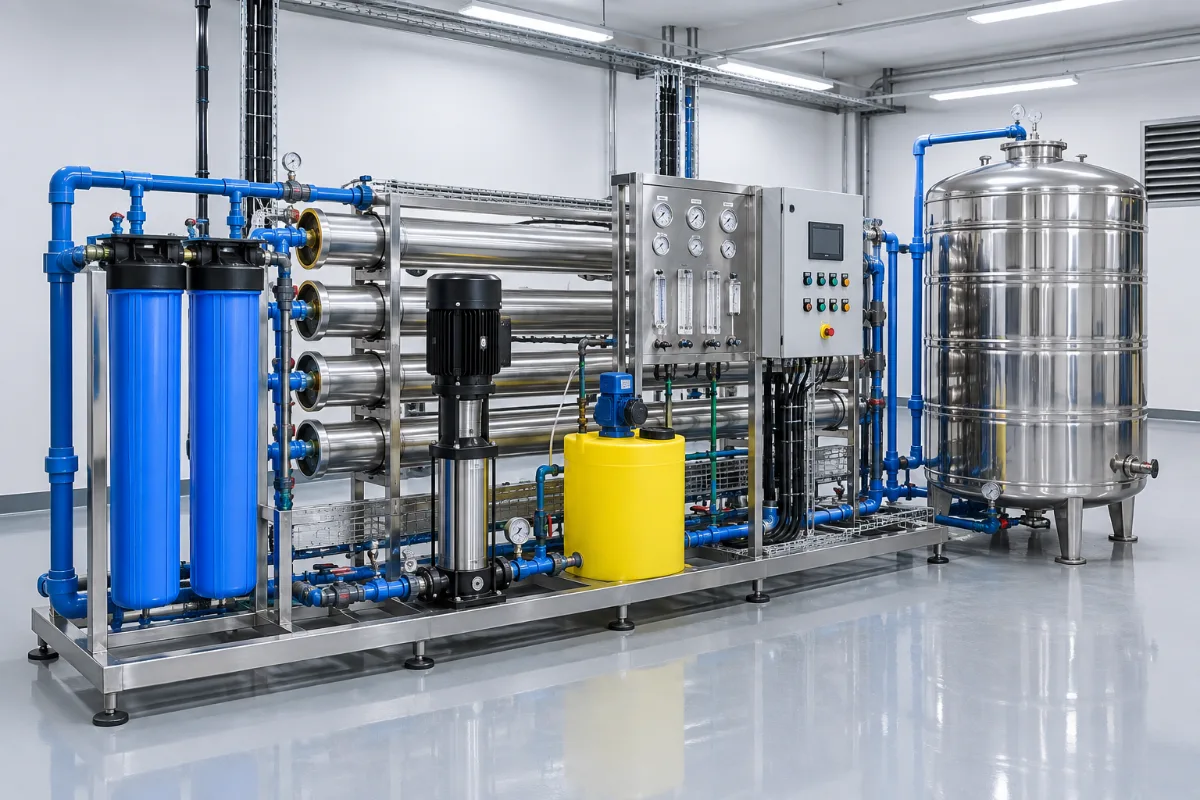
Start with a sand or multimedia filter for suspended solids and turbidity, followed by a 5 micron cartridge filter. If iron or manganese is over the limit, put an oxidation and filtration unit ahead of everything else, because iron fouls RO membranes and blocks emitters faster than any other contaminant on a farm, which is why iron removal comes before the membranes in every hydroponics water treatment in Oman design we build. Our guide to well water treatment in Oman covers the borehole side in detail.
4. Reverse osmosis and smart blending
An RO unit removes about 97 percent of dissolved salts and most of the sodium, chloride and boron. Running a greenhouse on pure RO water is wasteful though: you strip out the calcium and magnesium, then buy them back as fertiliser. The practical answer in hydroponics water treatment in Oman is blending. Mix RO permeate with filtered well water at a ratio that puts final EC and sodium under your limit. On a well at 2.4 mS/cm, roughly 70 percent RO to 30 percent filtered water is usually enough, which cuts both the unit size you need and the running cost.
Plan for the reject stream as well. It can wash floors, irrigate salt-tolerant crops or go to date palms instead of down a drain, which we covered in the RO reject water guide.
5. Bicarbonate and pH control
High bicarbonate pushes nutrient solution pH above the 5.5 to 6.5 target range. Iron then stays in solution but the plant cannot take it up, so you see iron deficiency symptoms while the analysis shows iron present. The fix is nitric or phosphoric acid injection sized against measured alkalinity, dosed through a metering pump with pH control rather than by hand. Count the nitrogen and phosphorus the acid adds into the nutrient recipe instead of dosing on top of it.
6. Disinfection and biofilm control
Warm nutrient-rich water in drip lines is ideal for biofilm and for root pathogens such as Pythium and Fusarium. In recirculating systems disinfection is not optional. A UV steriliser dosed for horticulture on the return line is the most used option, because it leaves no chemical residual to harm roots. Stabilised hydrogen peroxide handles line cleaning between cycles. See our UV steriliser systems for unit specifications.
7. Daily EC and pH monitoring
Measure EC and pH in the tank and in the drain at least once a day, and log both. Drain EC rising against feed EC means salt accumulation that needs a flush or a partial dump. Send a full laboratory analysis of the solution every four to six weeks to track sodium and chloride specifically, because those are what build up silently while everything still looks normal. A logged trend is the whole point of hydroponics water treatment in Oman: you act on a number in week one instead of a crop in week ten.
Who watches hydroponics water treatment in Oman daily
The equipment is the easy part. Success depends on one named person reading the numbers every day: EC, pH and tank temperature, written down. Farms that skip the log find out from yellowing leaves two weeks later, after losing part of a cycle. Set a weekly schedule for filter backwash and membrane checks, and re-analyse the well twice a year. Both are far cheaper than replacing a membrane set or replanting a greenhouse.
What a hydroponics water treatment in Oman service covers
- Full well water analysis: EC, hardness, sodium, chloride, bicarbonate, iron and boron
- RO unit sized to the number of greenhouses and daily consumption, with the blending ratio set
- Pre-filtration and iron removal ahead of the membranes
- Acid dosing for alkalinity and pH, and UV disinfection on the recirculation line
- Service contract with dated test reports and operator training on the daily log
UV Water Systems designs, supplies, installs and services hydroponics water treatment in Oman for greenhouses and farms in Muscat, Batinah and the interior. Call +968 9763 7786 or email sales@waterfilteroman.com with your water analysis for a technical proposal.
Frequently asked questions
Can hydroponics run on raw well water in Oman?
Rarely. A well under 1.0 mS/cm with low sodium and low bicarbonate can work with filtration and acid dosing alone. Most Omani wells test well above that, and the salts concentrate in a recirculating system until growth suffers.
What RO capacity does a greenhouse need?
Size it on daily consumption, not greenhouse area alone. Work out litres per day at peak summer demand, add the blending ratio, and add a buffer tank so the unit runs steadily instead of cycling. Send crop type, area and the water analysis and the sizing is straightforward.
Do I need RO if I use municipal supply?
Usually not for salinity, since desalinated municipal water is low in TDS. You still need filtration, pH and alkalinity control, and disinfection on a recirculating line.
How often are RO membranes replaced on a farm?
Three to five years with correct pre-filtration, antiscalant dosing and cleaning. On iron-bearing well water without proper pre-treatment, within a year.
For supply and service, see our hydroponics RO plant in Oman page — 500 to 5,000 LPH packages and AMC scope.