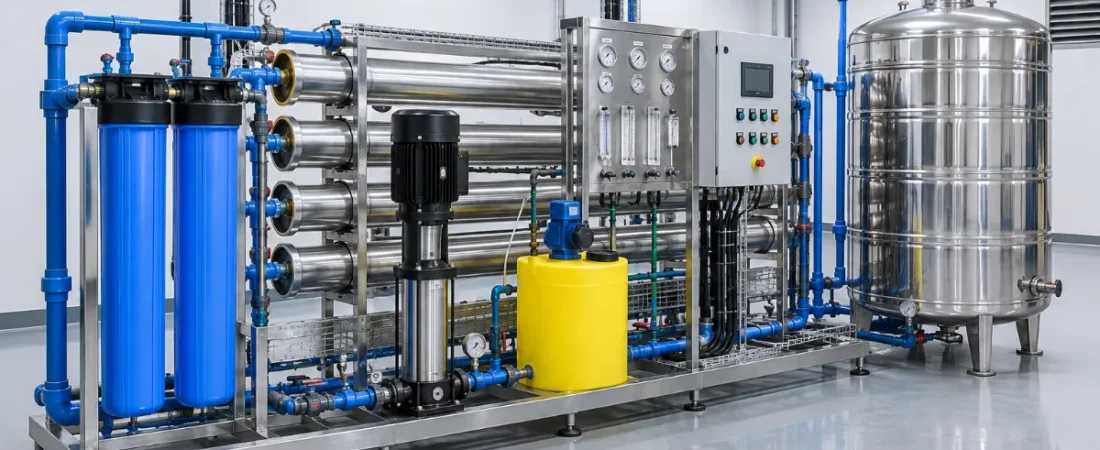
RO antiscalant in Oman is the cheapest insurance policy you can buy for a reverse osmosis plant. A 25 kg container costs a fraction of one membrane set, yet the wrong product or the wrong dose will scale a membrane bank in weeks. This guide explains how UV Water Systems selects an RO antiscalant in Oman, how the dose is calculated from your feed water analysis, and the seven mistakes that cost operators membranes every year.
What this guide covers
- Why scale is the main threat in Omani feed water
- Which RO antiscalant in Oman suits your water
- How the dose is actually calculated
- 7 dosing mistakes you should never make
- Antiscalant, acid dosing or softener pretreatment
- Storage, handling and safety
- Who is responsible on site
- FAQ
Why scale is the main threat in Omani feed water
Most RO plants in Oman run on one of three feed waters: municipal supply from Nama Water Services, brackish well water, or recovered process water. All three carry scale formers. Well water in Barka, Quriyat, Suwaiq and the interior commonly shows 2,500 to 12,000 mg/l TDS with calcium above 400 mg/l, sulphate above 600 mg/l and silica between 20 and 45 mg/l. Municipal supply is far lower in TDS but still carries enough calcium carbonate alkalinity to scale a membrane running at 75 percent recovery.
Scale forms on the last elements of the last stage first, because that is where the concentrate is most saturated. The symptoms arrive in a predictable order: normalised permeate flow drops, differential pressure across the stage climbs, salt passage rises, and feed pressure has to be raised to hold output. By the time the operator notices the pressure, the deposit is already there.
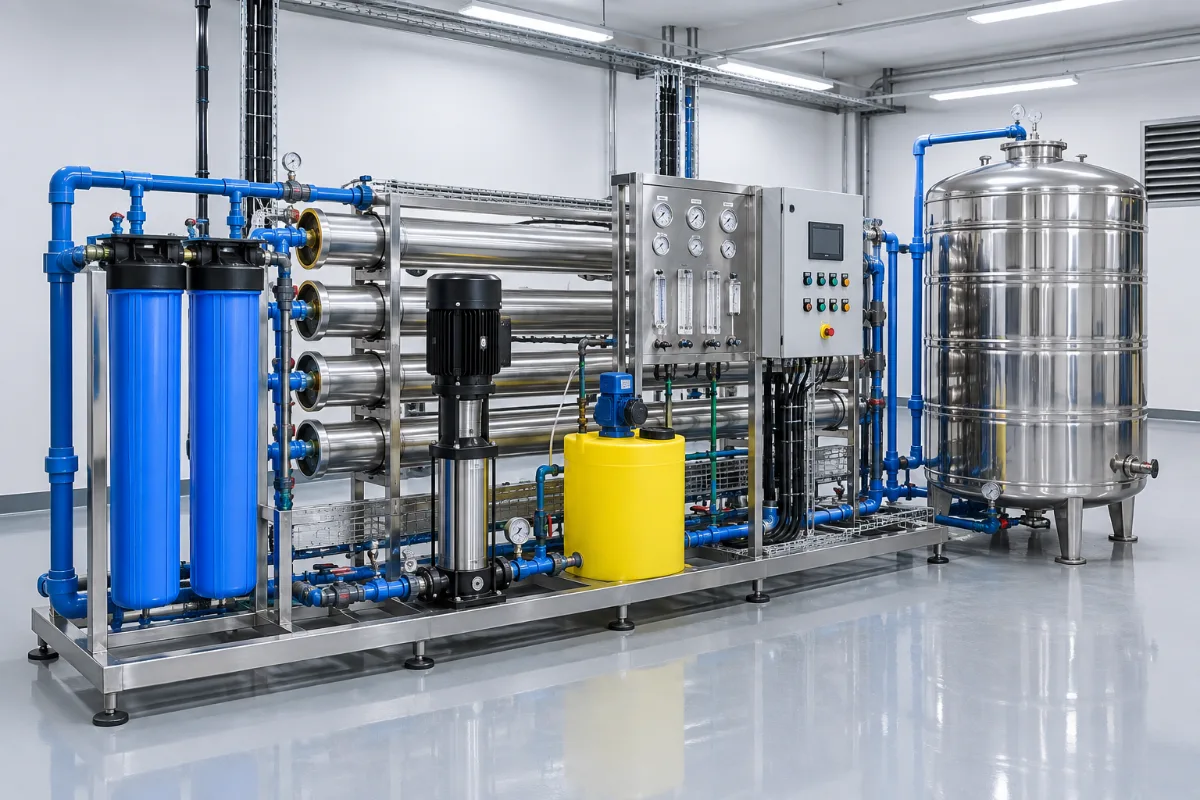
Which RO antiscalant in Oman suits your water
There is no universal product. Selection depends on which salt sits closest to saturation in your concentrate stream, the recovery you are designing for, and whether the membrane manufacturer has approved the chemistry. UV Water Systems stocks three professional antiscalants in 25 kg containers:
| Product | SKU | Typical use |
|---|---|---|
| Nalco PermaTreat PC-191T | UVS-PC191T-25KG | Broad-spectrum carbonate and sulphate control on brackish well water and high-recovery plants |
| Veolia Hydrex 4109 | UVS-HYD4109-25KG | General RO pretreatment where carbonate scale and moderate silica are the main risk |
| Culligan Scale Guard 50M17 | UVS-SG50M17-25KG | Commercial and light industrial plants on municipal or blended feed |
If you run a plant and cannot say which of these three your feed water needs, that is the real answer to the question. Send a full water analysis first. Any supplier who recommends an RO antiscalant in Oman without seeing calcium, magnesium, alkalinity, sulphate, silica, barium, strontium, pH and temperature is guessing with your membranes.
How the dose is actually calculated
The dose comes out of a projection, not a rule of thumb. The sequence is:
- Run the feed analysis through membrane projection software at your design recovery and temperature.
- Read the saturation indices in the concentrate: LSI for calcium carbonate, and percentage of saturation for calcium sulphate, barium sulphate, strontium sulphate, calcium fluoride and silica.
- Compare each figure against the inhibited limit the antiscalant supplier publishes for that chemistry.
- Take the dose that holds every index inside its limit, then add margin for seasonal temperature swing. In Oman that swing is large: a well at 28 °C in January and 36 °C in August behaves differently on silica.
- Set the dosing pump stroke and frequency to deliver that dose at the actual feed flow, and verify it by drawdown from a calibration cylinder rather than by the pump dial.
Typical doses land between 2 and 6 mg/l of product on feed, but quoting a number without the projection is exactly the habit this section exists to break. DuPont FilmTec technical manuals and projection software set out the saturation limits most antiscalant programmes are designed against.
7 dosing mistakes you should never make
- Dosing after the cartridge filter. The injection point belongs upstream of the 5 micron cartridge so the chemical is mixed and any undissolved carrier is caught before the membranes.
- Diluting with permeate and leaving it for weeks. Dilute antiscalant in a day tank is a nutrient source. Make up only what you will use within a week, keep the tank covered, and clean it at every service.
- Running antiscalant and a cationic polymer or oxidising biocide into the same line. Anionic antiscalants and cationic polyelectrolytes precipitate on contact and the resulting gum fouls the lead elements.
- Leaving the dose unchanged when recovery changes. Raising recovery from 70 to 80 percent roughly doubles the concentration factor on the tail element. The dose has to be reprojected.
- No low-level switch and no no-flow interlock. An empty chemical drum with the high pressure pump still running is how a membrane bank scales overnight.
- Treating the chemical as a cure for iron, manganese or turbidity. An RO antiscalant is a scale inhibitor. Iron and colloids need their own pretreatment.
- Never normalising the data. Without normalised flow and salt passage you cannot tell whether the RO antiscalant programme is working or quietly failing.
Antiscalant, acid dosing or softener pretreatment
An RO antiscalant in Oman is usually the lowest-cost route, but it is not the only one. Acid dosing lowers pH and converts bicarbonate to carbon dioxide, which controls carbonate scale but does nothing for sulphate or silica and adds a corrosion and handling burden. Softener pretreatment removes hardness completely and suits small plants and boiler feed duty, but regeneration consumes salt and water, and it does not remove silica either. On brackish well water at high recovery, antiscalant almost always wins on operating cost. For the cooling side of the same argument see cooling tower scale treatment in Oman, and for steam plant see boiler feed water treatment in Oman.
Storage, handling and safety
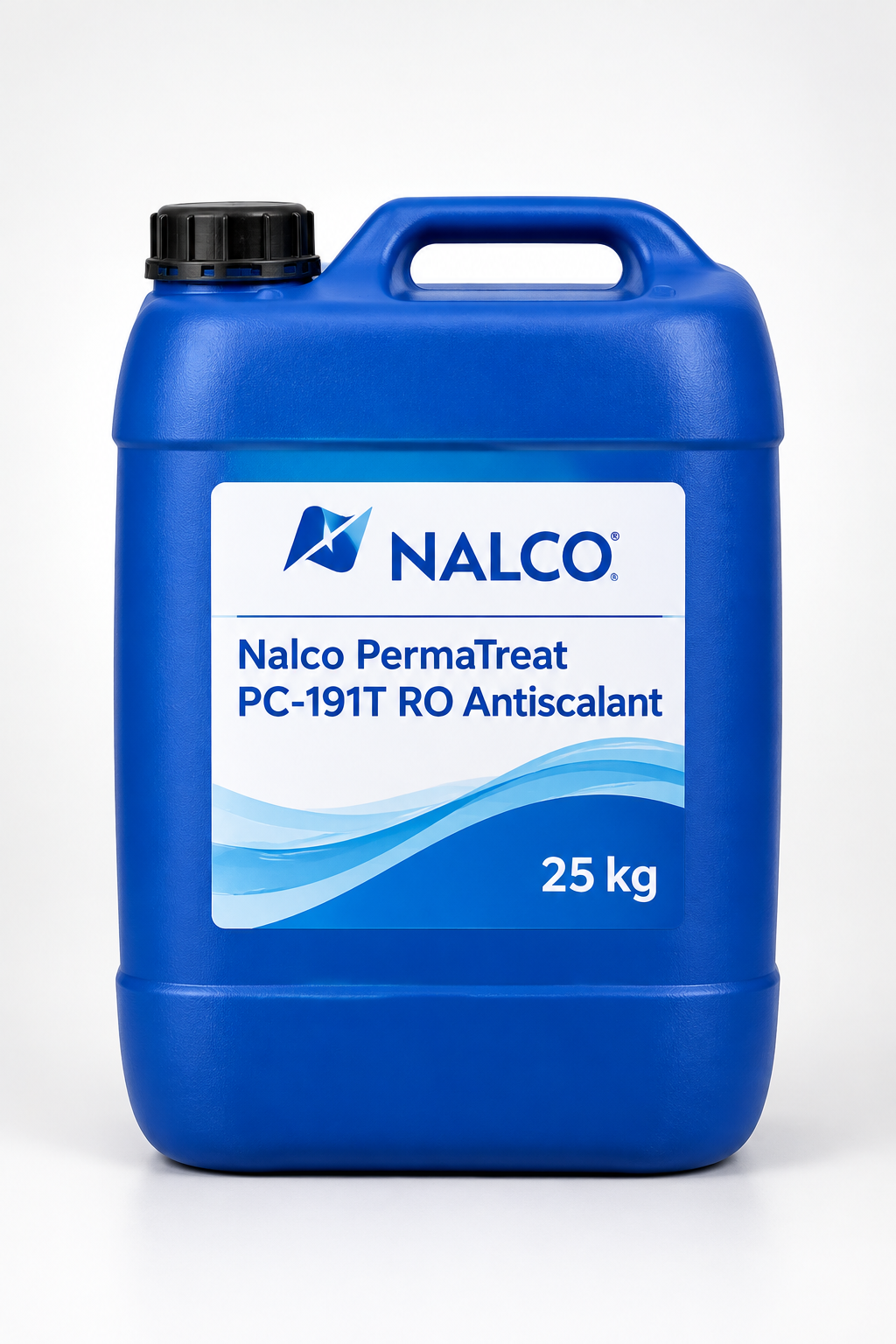
All three products are supplied in 25 kg containers. Store them indoors between 5 and 40 °C, out of direct sun, closed, on a bunded pallet. Keep the safety data sheet at the dosing station, not in an office drawer. Operators need gloves, goggles and an eyewash point within reach. Do not decant into unlabelled containers, and never store an antiscalant beside an oxidising biocide. Shelf life is typically 12 to 24 months unopened; record the batch and date on receipt.
Where the permeate feeds drinking water, confirm the product carries drinking-water approval for that application and that the dose stays inside the approved limit. The WHO drinking-water quality guidelines are the reference point for the finished water.
Who is responsible on site
Scale failures are nearly always a split-responsibility problem. Agree this in writing before commissioning:
- Plant owner or facility team keeps the chemical in stock, logs drum changes, reports alarms and gives access.
- Operator records feed and permeate flow, pressures, conductivity and tank level daily, and verifies the dosing pump by drawdown weekly.
- Water treatment contractor reprojects the dose when feed water or recovery changes, calibrates pumps, normalises the data, and calls the cleaning before differential pressure reaches the limit.
Service visit checklist: dosing pump drawdown verified, drum level and batch recorded, injection point and non-return valve checked, day tank cleaned, cartridge filter differential noted, normalised permeate flow and salt passage plotted, concentrate saturation recalculated against the latest analysis, safety data sheet present at the station.
FAQ
How much RO antiscalant does a 1,000 LPH plant use?
At 4 mg/l on a feed flow of about 1,400 LPH, roughly 0.14 kg per day, so a 25 kg container lasts around six months. Your own projection may give a different figure.
Can I switch brands without changing the dose?
No. Inhibited saturation limits differ between chemistries. Reproject before you switch.
Does antiscalant remove existing scale?
It does not. Existing deposit needs a membrane clean with the correct acid or alkaline cleaner, after which the antiscalant programme keeps it from returning.
Do you supply the dosing equipment as well?
Yes. UV Water Systems supplies dosing pumps, day tanks, injection assemblies, level switches and the service programme alongside the chemical.
Get the right RO antiscalant for your plant
Send your feed water analysis and plant details to UV Water Systems in Muscat. We will project the saturation indices, recommend the product and dose, and quote the chemical together with the dosing equipment. Call +968 9763 7786 or email sales@waterfilteroman.com.