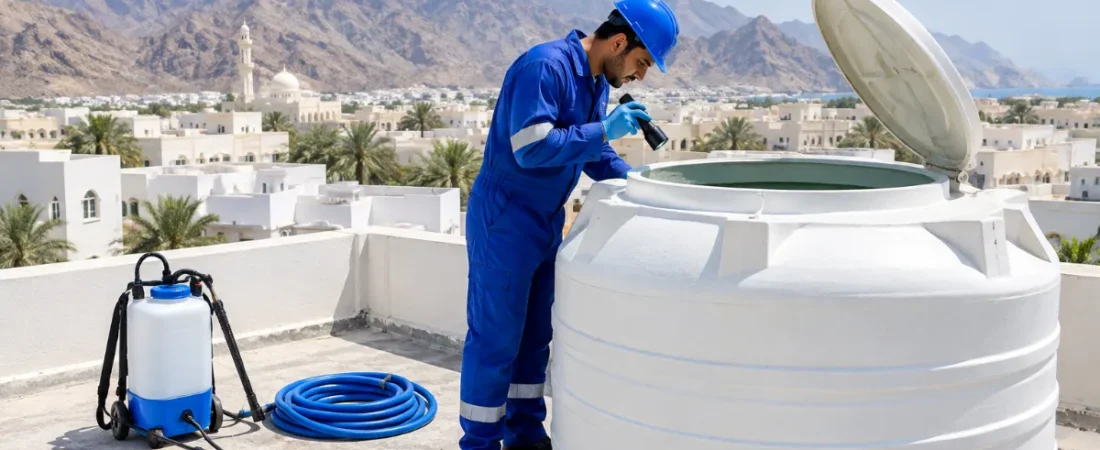
Legionella control in Oman matters more than most building owners realise. Roof tanks sit in 45 C air for six months of the year, and the water inside them drifts into the exact temperature band where Legionella pneumophila multiplies fastest. This guide gives you the seven checks we run on hotel, hospital and labour accommodation systems across Muscat, and what each one costs you if you skip it.
What this guide covers
- Why legionella control in Oman is harder
- 1. Measure cold water temperature at the tap, not the tank
- 2. Hold hot water at 60 C in storage
- 3. Find and remove dead legs
- 4. Clean and disinfect tanks twice a year
- 5. Flush low-use outlets weekly
- 6. Descale shower heads and spray taps
- 7. Sample and test, do not assume
- Building a written control plan
- Who is responsible
- FAQ
Why legionella control in Oman is harder than in Europe
Legionella multiplies between 20 C and 45 C and goes dormant below 20 C. In the UK or Germany, cold water lines stay naturally below 20 C most of the year, so half the problem solves itself. In Oman it does the opposite. We regularly log cold water leaving a roof tank at 38 C to 42 C in July, and the first litre out of a guest room tap at over 40 C. That is incubator temperature.
Add the three conditions Legionella needs to become dangerous and the picture is clear: warm water, stagnation in low-occupancy rooms, and scale or biofilm for the bacteria to feed on. Hard Omani supply water delivers the third condition for free. This is why legionella control in Oman cannot be copied straight from a European manual. The temperature strategy has to be designed for a hot climate.
The exposure route is breathing in aerosol, not drinking. Showers, spray taps, cooling towers, decorative fountains and spa pools are the delivery mechanisms. The UK HSE temperature guidance remains the clearest reference on the control limits, and the CDC water management programme toolkit is the best free template for writing the plan itself.
1. Measure cold water temperature at the tap, not the tank
Most sites that think they have no problem have never measured in the right place. Run the outlet for two minutes and record the stabilised temperature at the furthest and the least used taps on every floor. Anything above 20 C is outside the control limit. Anything above 25 C needs a documented reason and a compensating control.
Practical fixes in Oman: insulate and, where possible, relocate roof tanks out of direct sun, insulate the full cold water run rather than the first metre, separate cold lines from hot risers in shafts, and add a tank chiller where guest comfort and legionella control in Oman both demand it. A chiller holding the stored cold water near 20 C solves a safety problem and a complaint problem in one spend.
2. Hold hot water at 60 C in storage
Calorifier or heater storage at 60 C, delivered so that every tap reaches 50 C within one minute. Below that, the hot side becomes a second breeding ground instead of a control. Check the return leg temperature on circulating systems, because a dead return means the far end of the loop is sitting lukewarm.
Where scald risk matters, the answer is a thermostatic mixing valve at the outlet, not a lower storage temperature. Keep the stored water hot and mix it down at the last moment. Those mixing valves then need their own strainer and service schedule.
3. Find and remove dead legs
A dead leg is a capped spur, a removed fixture left piped, or a bathroom that was reconfigured and never re-plumbed properly. Water sits there at room temperature indefinitely and seeds the rest of the system. On older Muscat buildings we find dead legs on nearly every survey.
Walk the system with the as-built drawings, mark every branch that does not end at a live outlet, and cut it back to the main. This is the cheapest permanent win in legionella control and it never needs doing twice.

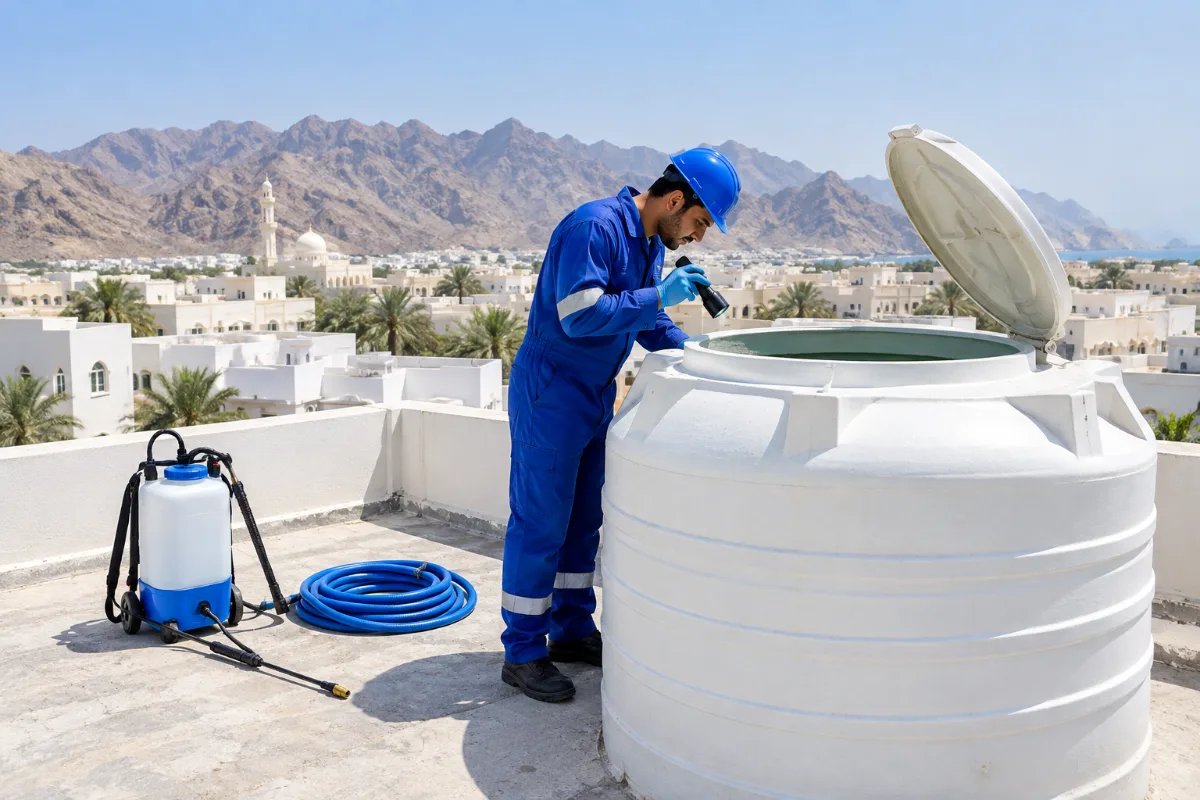
4. Clean and disinfect tanks twice a year
Drain, physically scrub, remove sediment, then chlorine disinfect and flush. Annual is the usual recommendation; in Oman twice a year is the realistic interval because sediment and biofilm build faster at high temperature. Inspect the lid seal, the insect screen on the overflow and the vent while the tank is empty, since a bird or rodent entry point undoes everything else.
We cover the method in detail in our guide to water tank cleaning in Oman.
5. Flush low-use outlets weekly
Empty hotel rooms, unoccupied villas, spare bathrooms and seasonal facilities are where outbreaks start. Run every unused outlet for several minutes once a week until the water runs at the expected temperature, and log it. A tick sheet signed by housekeeping is acceptable evidence; memory is not.
Automatic flushing valves on a timer are worth the money on any property with regular long vacancies. They remove the one control that depends entirely on staff discipline, which is the one that always slips first.
6. Descale shower heads and spray taps
Scale gives biofilm somewhere to anchor, and a shower head is the single most efficient aerosol generator in the building. Clean and descale heads and hoses quarterly, and replace perished flexible hoses rather than cleaning them. A whole-building water softener in Oman cuts the rate of scale formation and reduces this workload across every outlet at once.
7. Sample and test, do not assume
Temperature logs tell you whether your controls are working. Microbiological sampling tells you whether the bacteria are there. Sample from the tank, from a sentinel tap at each extreme of the system, and from any shower serving vulnerable occupants. Use an accredited laboratory and the standard culture method, which takes around ten days.
In a hospital, dialysis unit or aged care facility, routine sampling is not optional. For a hotel or accommodation block, quarterly sampling plus continuous temperature control is a defensible programme. Any detection above the action level triggers immediate disinfection and a re-sample, not a wait and see.
Building a written control plan
Effective legionella control in Oman is a document, a responsible person and a logbook, not a one-off visit. The plan names who owns each control, records a schematic of the system, lists every asset with its risk rating, and sets the frequency for each check above. Auditors, insurers and increasingly hotel brand standards ask to see it.
Where a cooling tower is involved, the water treatment programme and the legionella plan have to be written together. Our post on cooling tower scale treatment in Oman covers the chemistry side.
UV Water Systems carries out risk assessments, tank cleaning and disinfection, chlorine dioxide and UV installation, mixing valve servicing and sampling programmes for buildings across the Sultanate. Call +968 9763 7786 or request a free water test in Oman to start.
Frequently asked questions
Is legionella testing mandatory in Oman?
There is no single standalone Omani legionella regulation covering every building type. Healthcare facilities, hotels operating to international brand standards and many oil and gas contractors impose it through their own HSE requirements and contracts, and Oman Standards for drinking water quality apply to the supply itself.
Can a UV steriliser alone solve Legionella?
No. UV disinfects water as it passes the lamp and leaves no residual, so anything growing downstream in the tank, pipework or shower head is untouched. UV is a useful layer on an incoming line or a recirculating loop, never the whole answer.
What does a legionella risk assessment cost in Oman?
It depends on the number of tanks, risers and outlets. A single villa is a short visit; a hotel with multiple calorifiers and a cooling tower is a full survey with a schematic. We quote per site after a walk-through, and the assessment is priced separately from any remedial work.
How quickly can Legionella colonise a new system?
Weeks, if the system is commissioned and then left stagnant and warm, which is exactly what happens between practical completion and handover on many Oman projects. Commissioning should include a disinfection and a flushing regime that continues until the building is occupied.
Who is responsible for legionella control in Oman
Responsibility sits with whoever controls the building, not with the plumber who installed the pipes. For a hotel that is the general manager and the chief engineer. For a hospital it is the facilities department and the infection control committee. For labour accommodation it is the main contractor or the camp operator named in the HSE plan. Legionella control in Oman fails most often because nobody was formally named, so the flushing log stopped three months after handover and nobody noticed.
Assign one person by name, give them the written scheme, and review it twice a year. Hotel brand audits and oil and gas HSE audits both ask for that name first. If you outsource the work, you still own the risk: the contractor delivers the tank cleaning, the sampling and the temperature logs, while you keep the record that proves legionella control in Oman is being managed on your site.
What a legionella control in Oman service visit includes
- Temperature readings at sentinel hot and cold outlets, logged against the 20 C and 50 C limits
- Tank inspection, cleaning and chlorine disinfection with before and after readings
- Shower head and spray tap descaling or replacement
- Flushing schedule for low-use rooms, written for the housekeeping team
- Water sampling through an accredited laboratory, with a dated report you can hand to an auditor
UV Water Systems carries out legionella control in Oman work on hotels, hospitals, schools and accommodation blocks across Muscat and the interior. Call +968 9763 7786 or email sales@waterfilteroman.com for a site survey and a written scheme for your building.