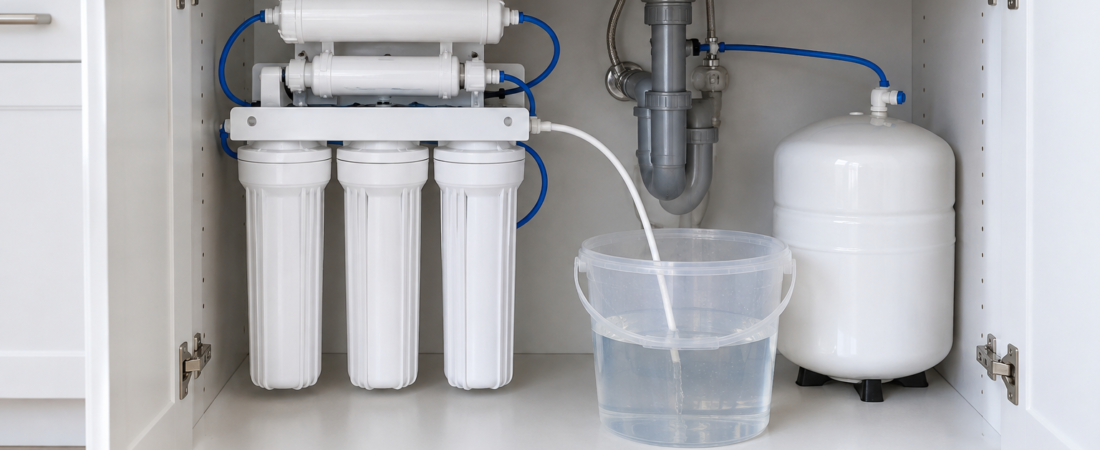
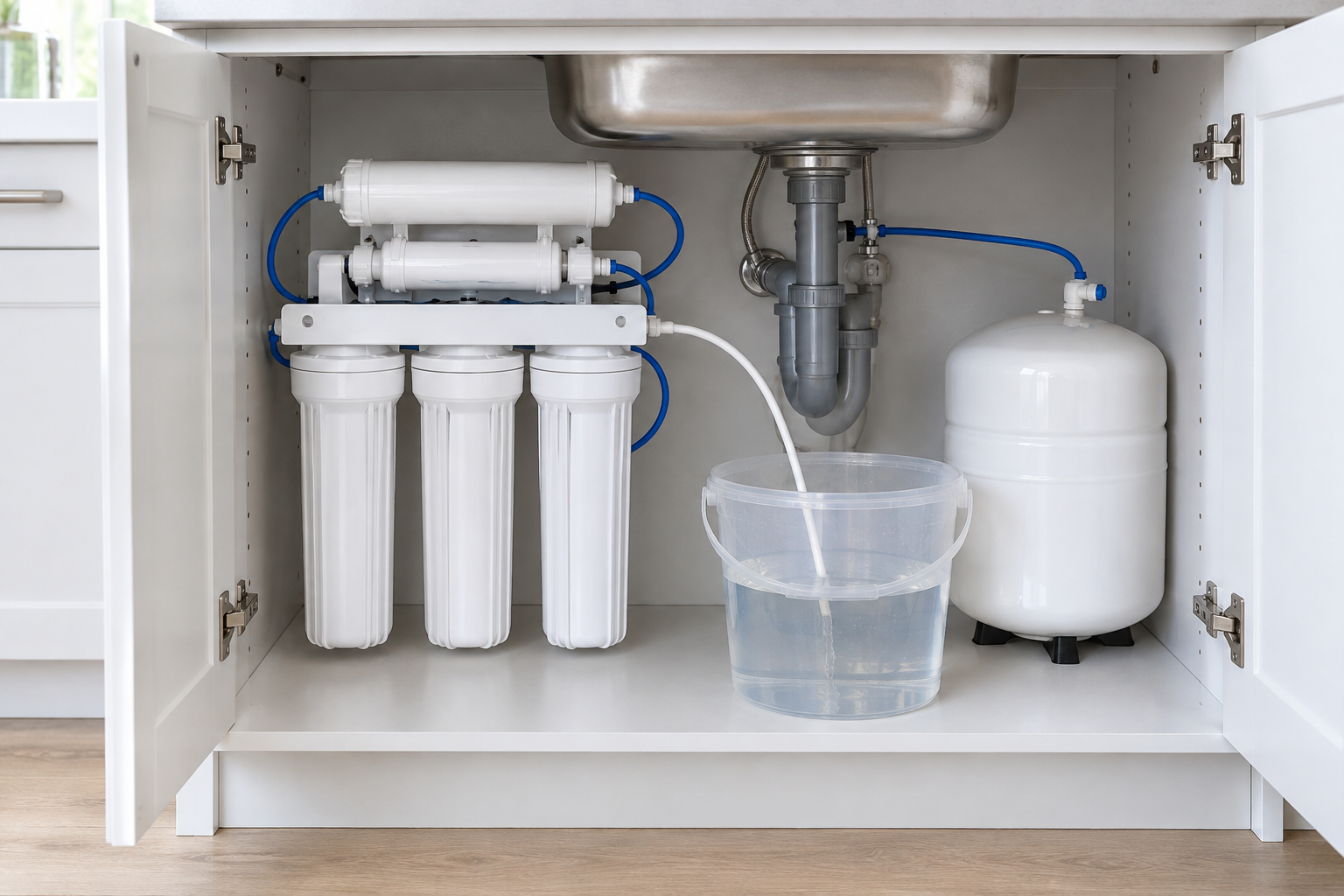
Every domestic reverse osmosis unit sends water down the drain. In a country where every litre of mains supply was desalinated at cost, that bothers people, and it should. RO reject water in Oman typically runs at three to four litres discharged for every litre you drink. This guide explains where that ratio comes from, how to cut it, and which of the popular reuse ideas actually work in an Omani villa.
In this guide
- How much water an RO really wastes
- Why the reject exists at all
- 4 ways to cut RO reject water in Oman
- 7 reuse ideas, honestly rated
- What not to do with it
- FAQ
How much water an RO really wastes
| Setup | Reject per 1 L of drinking water | Typical daily reject for a family |
|---|---|---|
| Standard domestic RO, no pump | 3 – 4 L | 30 – 60 L |
| Domestic RO with permeate pump | 1 – 1.5 L | 10 – 20 L |
| Booster-pumped RO on low feed pressure | 2 – 3 L | 20 – 40 L |
| Commercial RO with recirculation | 0.3 – 1 L | Designed case by case |
The numbers that matter to a household are in the second column. A family drinking 15 litres a day on a standard unit is sending 45 to 60 litres to the drain. Over a year that is the volume of a small swimming pool.
Why the reject exists at all
The membrane separates water from the salts dissolved in it. Those salts have to leave somewhere. The reject stream is what carries them away and keeps the membrane surface from scaling up. Reduce the flow too far and the membrane fouls and dies early, which is why the restrictor fitted to your unit is sized, not arbitrary.
The practical consequence: RO reject water in Oman is not clean water being thrown away. It is your feed water concentrated. If your feed reads 300 mg/L, the reject is running around 900 to 1,500 mg/L. On a borehole villa at 3,000 mg/L feed, the reject is brine.
4 ways to cut RO reject water in Oman
1. Fit a permeate pump
A non-electric permeate pump uses the energy in the reject stream to push permeate into the tank. It typically cuts reject by half or more and speeds up tank filling. This is the single best upgrade on most domestic units and it costs less than a membrane.
2. Check your feed pressure
Low inlet pressure makes an RO work harder and waste more. If your villa runs on tank-fed gravity pressure, a small booster pump changes the whole picture.
3. Replace the membrane on schedule
A tired membrane passes less permeate for the same reject flow, so the ratio quietly gets worse over time. Our maintenance guide sets out the intervals.
4. Pre-treat properly on hard or high-TDS supply
Softening or filtering ahead of the membrane lets the unit run at a lower reject ratio without scaling. On well supply this is not optional; see well water treatment in Oman.
7 reuse ideas, honestly rated

| Use | Verdict |
|---|---|
| Washing floors, courtyards and driveways | Works well. The best everyday use |
| Toilet cistern flushing | Works, but needs plumbing or daily bucket filling |
| Pre-rinse when washing a car | Fine for the first rinse, not the final one. It leaves spots |
| Mopping and general cleaning | Works |
| Watering salt-tolerant plants | Only if feed TDS is low. See the warning below |
| Watering lawns, herbs or vegetables | No. Salt accumulates in the soil |
| Topping up a water heater, AC or ironing | No. It scales faster than tap water |
The plant question is the one people get wrong most often. On low-TDS Muscat mains, reject at 900 mg/L is borderline and acceptable for date palms and hardy shrubs. On a borehole villa, reject at 9,000 mg/L will kill the plant and salt the soil for years. Know your feed reading before you water anything with it. Our guide to water TDS in Muscat by area sets the expectation.
What not to do with it
- Do not drink it or give it to animals
- Do not feed it back into the RO inlet, which is a common internet suggestion and destroys membranes
- Do not run it into a roof tank that also supplies the house
- Do not store it for days in an open bucket in summer
That third point matters. We have been called out to villas where someone piped the drain line into the storage tank to save water and doubled the TDS of the whole house within a week.
FAQ about RO reject water in Oman
Is RO reject water safe to touch?
Yes. It is the same water that came into your house, just more concentrated. It is not sewage.
Can I use it in my washing machine?
We do not recommend it. Higher hardness means more detergent and more scale in the heating element.
Is a zero-waste RO real?
Units marketed that way usually return the reject into the hot water line, which simply moves the salt into your shower and water heater. It is not a saving.
How do I know my own ratio?
Time how long the unit takes to fill a measured jug from the drain line and from the faucet. The comparison gives you the ratio in about ten minutes.
This guide is also available in Arabic.
Cut your waste, not your water quality
We measure feed pressure, membrane condition and the actual reject ratio on service visits, and can quote a permeate pump upgrade for most domestic units. Book a free water test in Oman or call +968 9763 7786.