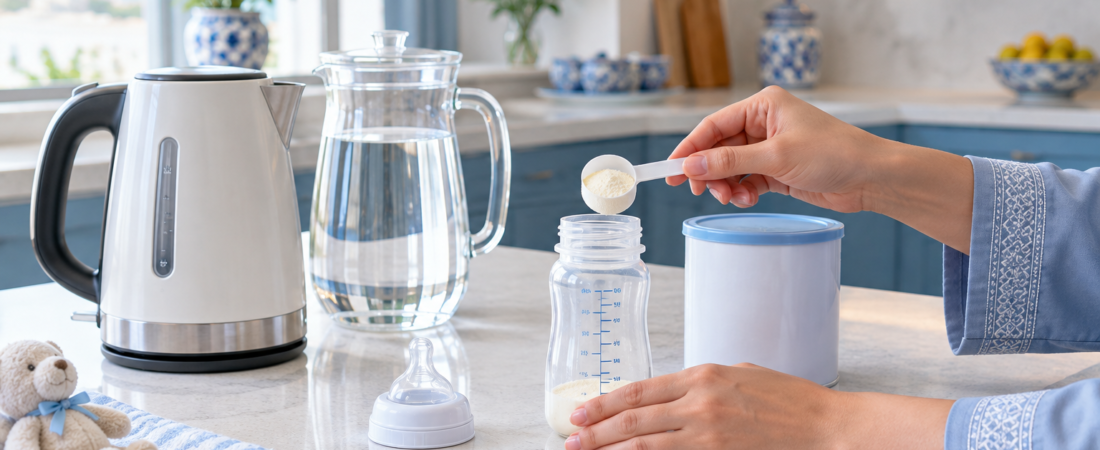
Choosing the right water for baby formula in Oman comes up in almost every young family we visit, and the advice they find online is contradictory. Some say bottled mineral water is safest. Some say RO water strips everything out. Some say boiling is enough. This guide sets out what actually matters: the water source, the mineral load, and the temperature at which you mix the feed. Talk to your paediatrician or health centre about your own baby; what follows is about the water, not about your child’s nutrition.
In this guide
- What matters in water for baby formula
- 7 rules for water for baby formula in Oman
- Muscat tap, bottled or RO: which source
- The mixing method, step by step
- Mistakes we see in Omani homes
- FAQ
What matters in water for baby formula
An infant’s kidneys handle a much smaller solute load than an adult’s. That makes three things relevant when you pick water for baby formula in Oman:
- Sodium and total minerals. Formula is already formulated with the minerals a baby needs. Water that adds a large extra mineral load works against that balance.
- Nitrate. Well and borehole water in agricultural areas can carry nitrate from fertiliser. This is the one contaminant where infants are genuinely more vulnerable than adults.
- Microbiological safety. Powdered formula is not sterile. This is why the mixing temperature matters as much as the water source.
7 rules for water for baby formula in Oman
1. Never use untreated well or tanker water
Borehole supply across Oman runs high in dissolved solids and can carry nitrate. If your villa is on a well or topped up by tanker, do not prepare feeds from it without treatment and a lab test. Start with well water treatment in Oman.
2. Low-mineral water is the right choice, not the wrong one
This is where people get confused by the mineral debate. For a baby, water that contributes very little sodium and calcium is an advantage, because the formula supplies those in measured amounts. Low TDS water for baby formula in Oman is appropriate. Our guide to RO water minerals in Oman covers this at length.
3. Check the label on bottled water before you trust it
Not all bottled water is low in minerals. Some brands sold in Oman are mineral waters with a high sodium or sulphate content. Read the analysis printed on the label rather than assuming that bottled means suitable.
4. Boil the water, once
Whatever the source, bring the water to a rolling boil, then let it cool. Repeated re-boiling of the same water concentrates whatever is dissolved in it.
5. Mix at around 70 degrees, not lukewarm
Water cooled to roughly 70 degrees Celsius kills bacteria that may be present in the powder itself. Water left to go cool first does not. This is the step most often skipped.
6. Cool the made-up feed quickly and use it within two hours
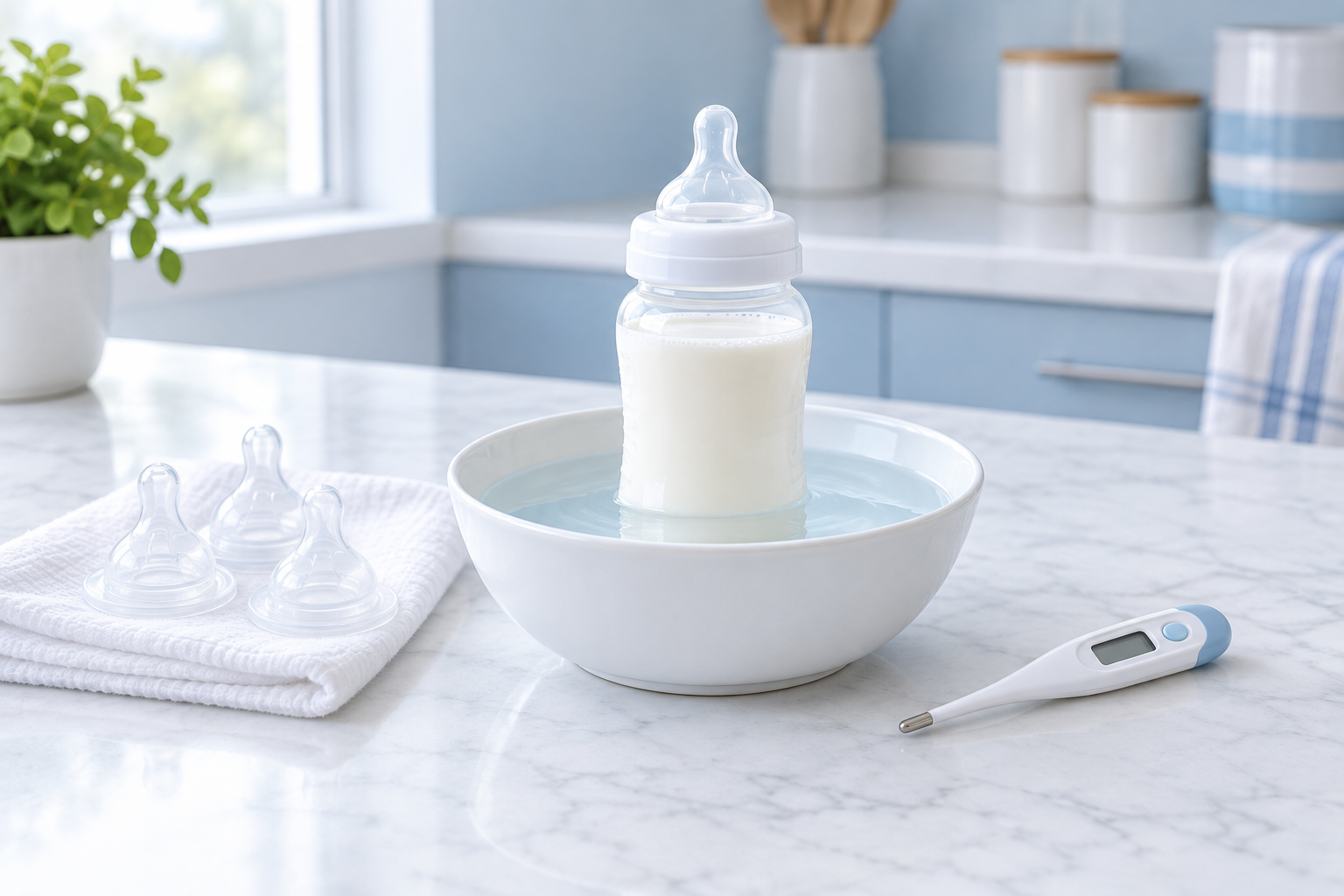
Stand the bottle in cool water to bring it down to feeding temperature. A prepared feed left standing at room temperature in a Muscat summer is a bacterial risk, not a convenience.
7. Service the filter that makes your water
A neglected RO unit is worse than no filter. Old carbon and a fouled membrane can add taste and bacteria rather than remove them. Follow the schedule in our water filter maintenance guide.
Muscat tap, bottled or RO: which source
| Source | Suitable | What to watch |
|---|---|---|
| Muscat mains, boiled | Yes | Roof tank cleanliness is the weak point, not the network |
| RO filtered, then boiled | Yes, our usual recommendation | Keep to the service schedule |
| Bottled low-mineral water, boiled | Yes | Check sodium and sulphate on the label |
| Bottled mineral water | Not ideal | Mineral load can be high |
| Well or tanker water, untreated | No | Nitrate and high TDS |
| Softened water from an ion-exchange softener | No | Softening exchanges hardness for sodium |
That last row surprises people. A softener does not reduce dissolved solids, it swaps calcium for sodium, which is the opposite of what you want here. See hard water vs high TDS in Oman.
The mixing method, step by step
- Wash your hands and sterilise the bottle and teat.
- Boil fresh water. Do not re-boil water that has already been boiled and stored.
- Let it stand about 30 minutes so it falls to roughly 70 degrees.
- Pour the measured water into the bottle first, then add the powder with the scoop supplied in the tin.
- Cap, shake, then cool the bottle under a running tap or in a bowl of cool water.
- Check the temperature on the inside of your wrist before feeding.
- Discard anything not finished within two hours.
Mistakes we see in Omani homes
- Preparing a full night’s bottles in advance and leaving them on the counter
- Filling from the softened supply because that tap is closer
- Using an RO unit whose cartridges were last changed two years ago
- Assuming a water dispenser bottle is filtered when it is simply stored
FAQ about water for baby formula in Oman
Is RO water safe for making baby formula?
Yes, and its low mineral content is an advantage here. Boil it before use like any other source.
Can I use Muscat tap water?
Mains supply is treated to drinking standard. Boil it, and make sure your building tank is clean. Our tank cleaning guide covers that.
Does boiling remove nitrate?
No. Boiling concentrates nitrate rather than removing it. RO is the practical treatment.
What about a UV steriliser instead?
UV deals with microbiology but leaves dissolved solids and nitrate untouched. See RO vs UV water purifier in Oman.
This guide is also available in Arabic.
Get your water tested before your baby arrives
If you are expecting, this is worth doing early. We test TDS, pH, hardness and chlorine free of charge across Muscat and will tell you whether your supply is suitable for preparing feeds. Book a free water test in Oman or call +968 9763 7786.
General information about water quality, not medical advice. Follow your paediatrician’s guidance for your own baby.