
Commercial RO system sizing in Oman is where most expensive mistakes start. A plant that is too small runs 24 hours a day, fouls early and still leaves the kitchen short at lunch. A plant that is too big costs more, sits idle and can grow bacteria in stagnant membranes. The right size comes from six numbers: feed water quality, daily demand, operating hours, recovery, storage and peak flow.
This guide explains each number, walks through a worked example for a commercial kitchen, and lists what the final design still needs before a quotation is fixed.
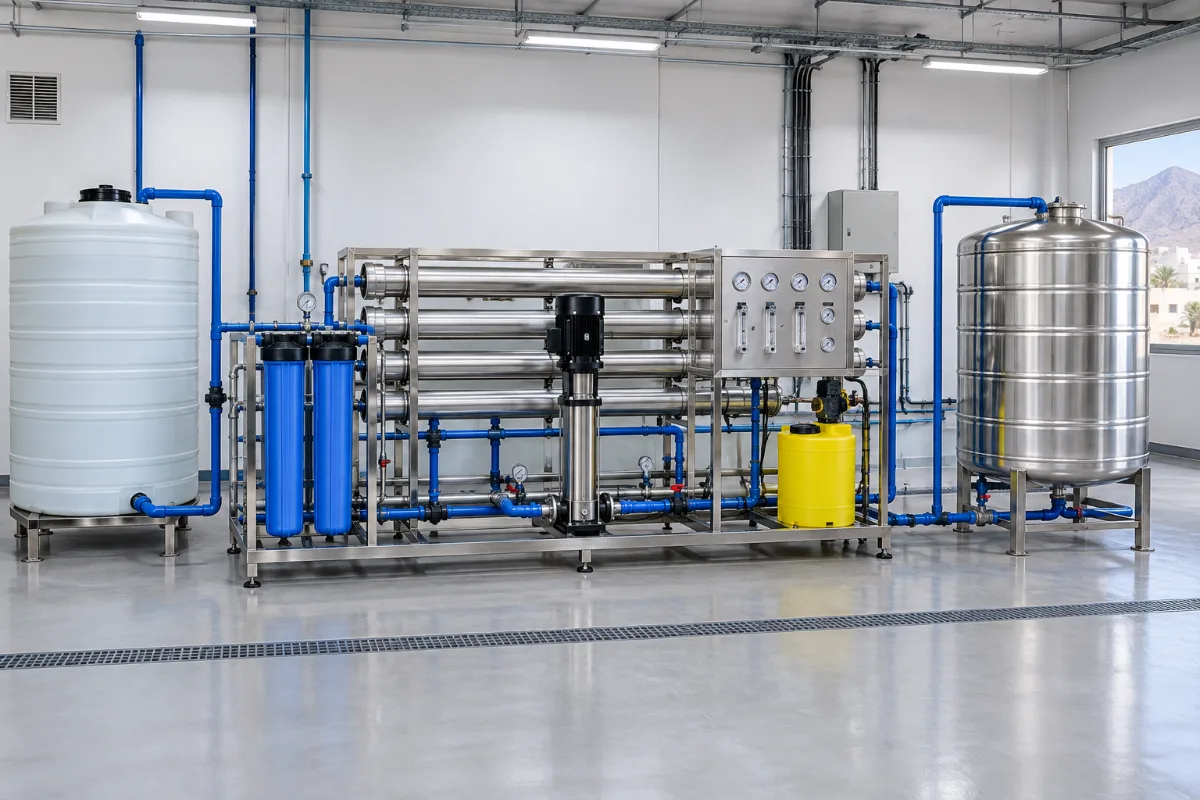
1. Start commercial RO system sizing with a feed-water analysis
Membrane choice, recovery and pre-treatment all depend on the water going in. Municipal supply in Muscat, tanker water and well water in Oman can differ by thousands of mg/L in TDS. Before sizing, test at least:
- TDS and conductivity
- Total hardness, calcium and alkalinity (scaling risk)
- Iron, manganese and silica
- Turbidity or SDI (fouling risk)
- Free chlorine (it damages polyamide membranes)
- Water temperature, which in Oman often sits at 30–40 °C in summer
You can arrange a sample through the official water sample testing service or ask us for a site test. If hardness is the main issue, read hard water vs high TDS in Oman first, because a softener may be needed ahead of the RO.
2. Calculate daily demand for commercial RO system sizing in Oman
List every point that needs RO water and estimate litres per day. Do not size on the total building water use: toilets, irrigation and cleaning rarely need RO quality.
| Use | Typical basis |
|---|---|
| Drinking water points | 2–3 L per person per day |
| Coffee machines | Manufacturer figure or measured use |
| Ice makers | Rated kg/day plus melt and rinse losses |
| Kitchen cooking and washing produce | Measured over a busy week |
| Process or lab use | Equipment specification |
For cafés, the water quality limits of the espresso machine matter as much as volume. See our coffee machine water filter guide.
3. Decide operating hours
RO plants produce at a steady rate. Divide daily demand by the hours the plant will run to get the net output in LPH. Designing for 20 hours rather than 24 leaves time for flushing, maintenance and demand growth.
4. Set recovery and check the reject flow
Recovery is product flow divided by feed flow. Commercial brackish RO units usually run between 50% and 75%, depending on scaling risk. Higher recovery saves water but concentrates hardness and silica on the membrane. The feed pump, pre-filters and drain must all be sized for the feed flow, not the product flow, and the reject line must have a legal, practical discharge point.
5. Size the storage tank
Storage is often the cheapest part of commercial RO system sizing in Oman, because it lets a modest plant cover sharp peaks. A kitchen may use a third of its daily RO water in two hours around lunch. The tank should cover the peak-period shortfall plus a reserve for maintenance stops. Stored RO water has no disinfectant residual, so plan for tank hygiene and consider UV on the outlet. Our RO vs UV comparison explains when both are needed.
6. Check peak flow to the outlets
The delivery pump after the tank must meet the highest instantaneous flow, for example several coffee machines, dishwashers and taps running together. This is a separate calculation from RO output.
Worked example of commercial RO system sizing in Oman
A central kitchen in Muscat needs 6 m³/day of RO water. Feed water is municipal supply with moderate hardness.
| Step | Calculation | Result |
|---|---|---|
| Net output | 6,000 L ÷ 20 h | 300 LPH |
| Design margin for fouling and temperature | 300 × 1.2 | 360 LPH |
| Selected plant | Next standard size | 500 LPH |
| Feed flow at 60% recovery | 500 ÷ 0.60 | ≈ 835 LPH |
| Reject flow | 835 − 500 | ≈ 335 LPH |
| Peak shortfall (2,000 L used in 2 h) | 2,000 − (2 × 500) | 1,000 L |
| Storage with reserve | 1,000 L + reserve | 2–3 m³ tank |
This example shows the method of commercial RO system sizing in Oman only. The final design needs a real water analysis, membrane projection software and a site survey of power, space and drainage.
Pre-treatment and post-treatment
Most commercial plants in Oman need sediment filtration, carbon to remove chlorine, and antiscalant dosing or softening. Hospitals and laboratories may also need UV, remineralisation or DI polishing. Our hospital water treatment case study shows a full 100 m³/day line, and industrial water treatment in Oman covers larger systems.
Common mistakes in commercial RO system sizing in Oman
- Sizing on a TDS pen reading instead of a full analysis.
- Using product flow to size the feed pump and pre-filters.
- Skipping storage and buying a bigger plant to cover peaks.
- Ignoring summer feed temperature and winter output drop.
- No space or drain for the reject water.
Water quality references are available in the WHO Guidelines for Drinking-water Quality. This guide is also available in Arabic: حساب سعة محطة RO التجارية في عمان.
Frequently asked questions
Can I size an RO plant from the TDS reading alone?
No. TDS gives the salt load but not the scaling or fouling risk, which decide recovery and pre-treatment.
Is GPD or LPH better for commercial plants?
Either works. 1,000 GPD is about 158 LPH. We quote in LPH and m³/day for projects in Oman.
How much space does a 500 LPH plant need?
Allow room for the skid, pre-filters, dosing, storage tank and service access. A site survey confirms the layout.
Get commercial RO system sizing in Oman done correctly
UV Water Systems designs, supplies and maintains commercial RO systems for restaurants, hotels, hospitals and industry across Oman. Book a water test or contact us with your demand figures for commercial RO system sizing in Oman based on your own water.