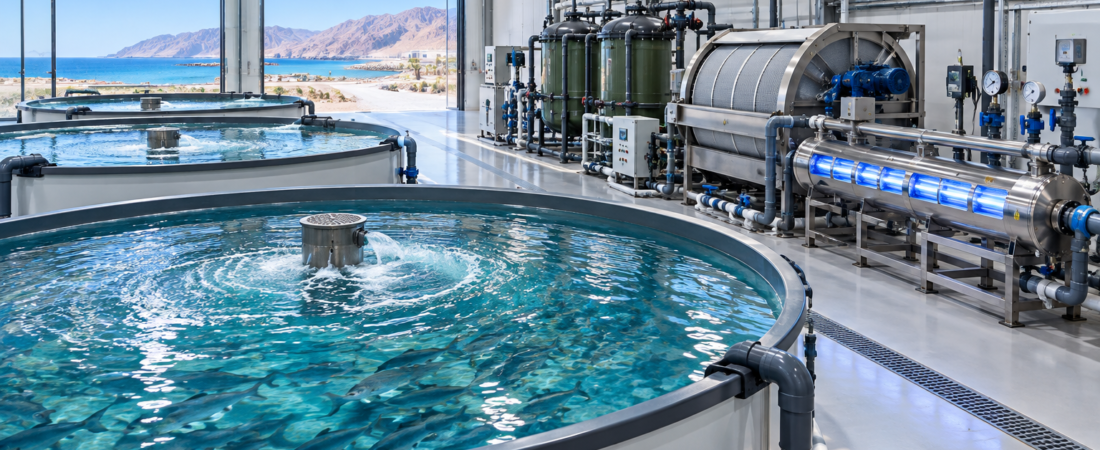
Aquaculture water filtration decides whether a fish or shrimp farm in Oman makes money or loses its stock. Fish live, eat and excrete in the same water, so without proper treatment ammonia, solids and pathogens build up within days. This guide explains how aquaculture water filtration works, which equipment a farm needs, and how to design a system that suits Oman’s hot climate and saline water sources.
Why Aquaculture Water Filtration Matters in Oman
Oman is investing heavily in aquaculture as part of its food security and economic diversification plans. New projects include marine fish cages, shrimp ponds, hatcheries and land-based recirculating aquaculture systems (RAS). Each of these depends on stable water quality.
Local conditions make this harder than in cooler countries:
- High temperatures: summer water temperatures above 30°C reduce dissolved oxygen and speed up bacterial growth.
- Saline and brackish sources: many inland farms use well water with high TDS, iron or hydrogen sulphide.
- Algal blooms: seawater intakes along the coast can carry algae and suspended solids during bloom seasons.
- Limited fresh water: farms must reuse water efficiently, which makes good treatment essential.
Key Water Quality Parameters for Fish and Shrimp
Every aquaculture water filtration system aims to keep a few parameters inside a safe range. Exact targets depend on the species, but typical guidelines are:
| Parameter | Typical Target | Why It Matters |
|---|---|---|
| Dissolved oxygen | Above 5 mg/L | Low oxygen causes stress, poor growth and mass mortality |
| Total ammonia nitrogen | Below 1 mg/L (un-ionised below 0.02 mg/L) | Toxic to gills, rises fast with heavy feeding |
| Nitrite | Below 1 mg/L | Blocks oxygen transport in blood |
| pH | 6.5–8.5 (marine 7.8–8.3) | Controls ammonia toxicity and fish health |
| Suspended solids | Below 25 mg/L | Clogs gills and feeds harmful bacteria |
| Temperature | Species specific | Affects oxygen, feeding and disease risk |
7 Stages of an Aquaculture Water Filtration System
1. Intake Screening
Coarse screens and strainers stop debris, seaweed and wild organisms from entering the farm. This is the first line of biosecurity.
2. Mechanical Filtration
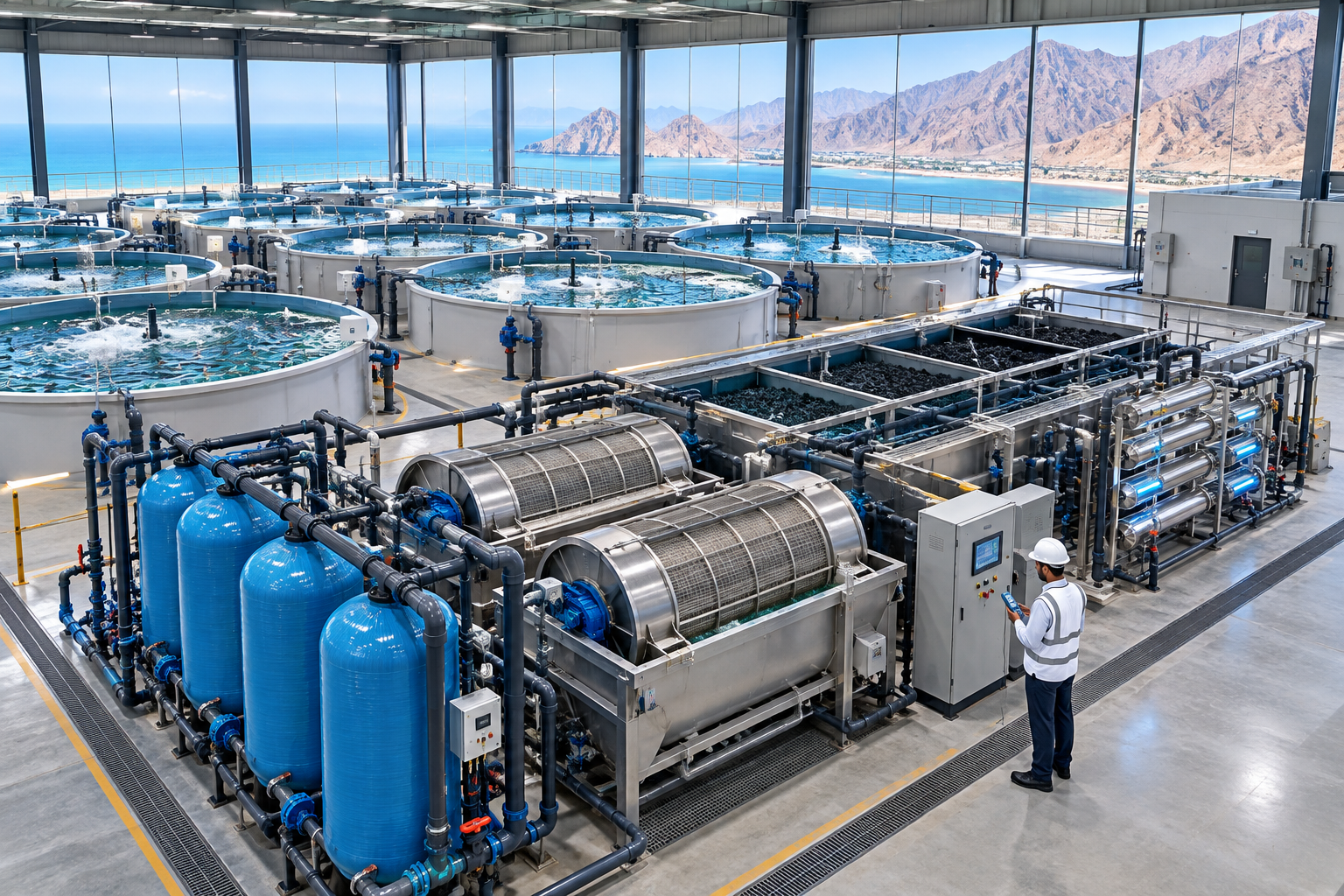
Drum filters, screen filters and sand or multimedia filters remove uneaten feed and fish waste before it breaks down. Rotary drum filters with 40–100 micron screens are the standard choice for RAS farms because they backwash automatically.
3. Biological Filtration
Moving bed bioreactors (MBBR) and trickling filters host nitrifying bacteria that convert toxic ammonia into nitrite and then into far less harmful nitrate. A well-sized biofilter is the heart of any recirculating aquaculture water filtration design.
4. Protein Skimming and Degassing
In marine systems, protein skimmers (foam fractionators) strip fine organics. Degassing towers remove excess carbon dioxide, which builds up in high-density tanks.
5. Disinfection with UV and Ozone
UV sterilizers kill bacteria, viruses and parasites without chemicals, which matters for food fish. Ozone improves water clarity and oxidises organics, but needs careful dosing and residual control. Many Oman hatcheries use both.
6. Oxygenation
Aerators, oxygen cones and pure oxygen injection keep dissolved oxygen high, especially during summer when warm water holds less oxygen.
7. Source Water Treatment
For inland farms using brackish wells, iron removal filters, softeners or reverse osmosis may be needed before the water reaches the tanks. Hatcheries often need RO water to adjust salinity accurately.
Flow-Through vs Recirculating Systems
Flow-through farms pump fresh seawater in and discharge it, so they need strong intake filtration and disinfection. Recirculating aquaculture systems (RAS) reuse 90–99% of their water, so they rely on mechanical, biological and UV treatment working together. RAS costs more to build but uses far less water and gives better control, which suits Oman’s water scarcity.
Common Problems We See on Farms
- Undersized biofilters that cannot handle peak feeding
- UV units without pre-filtration, so turbid water blocks the light
- No backup aeration during power cuts
- Sand filters that are not backwashed often enough and become a source of bacteria
- No routine testing for ammonia, nitrite and oxygen
How to Design Aquaculture Water Filtration for Your Farm
A good design starts with numbers: species, stocking density, daily feed, tank volume and source water analysis. From these we calculate the flow rate, solids load and ammonia load, then size each stage. Ask any supplier for these calculations in writing before you buy equipment.
For more on water quality standards in fish farming, see the FAO aquaculture resources.
Frequently Asked Questions
What is the best filter for a fish farm?
There is no single best filter. A complete aquaculture water filtration system combines a mechanical filter for solids, a biofilter for ammonia and a UV sterilizer for pathogens. The right sizes depend on your feed load and water volume.
How often should aquaculture filters be cleaned?
Drum filters clean themselves automatically. Sand and multimedia filters usually need backwashing daily or every few days, depending on the solids load. UV lamps should be replaced every 9,000 to 12,000 operating hours, and quartz sleeves cleaned monthly.
Can I use seawater directly for shrimp farming in Oman?
Seawater must be screened, filtered and disinfected first. Raw intake water can carry algae, sediment and disease organisms that wipe out a crop. Hatcheries need even finer filtration and often RO water for salinity control.
Is UV safe for fish?
Yes. UV treats the water inside a closed chamber and leaves no chemical residue, so it is safe for fish, shrimp and the people who eat them.
Aquaculture Water Filtration Oman: Work with UV Water Systems
UV Water Systems (Uniqueness View LLC) is an ISO 9001:2015 certified water treatment company in Muscat with over 14 years of experience. We design and supply aquaculture water filtration equipment across Oman, including sand and multimedia filters, UV sterilizers, RO plants for hatcheries, iron removal systems and chemical dosing. We also provide water testing, installation and annual maintenance contracts.
Explore our UV sterilizers and filtration systems, or call +968 9763 7786 to discuss your farm with our engineers.