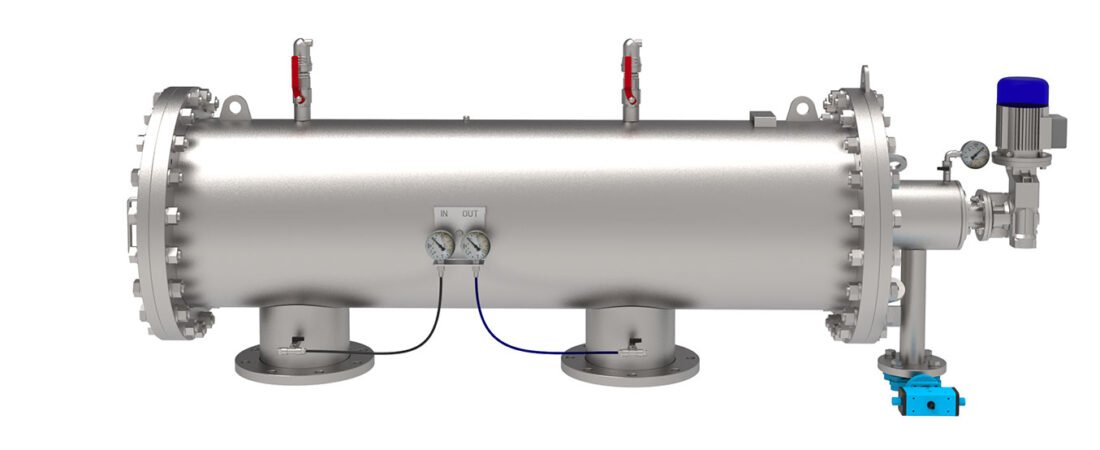
A self-cleaning water filter removes sand, silt, algae and debris from water and then cleans its own screen automatically, without stopping the flow. For factories, farms, cooling plants and RO systems in Oman, that means fewer shutdowns, no cartridges to replace and less work for the maintenance team. This guide explains how a self-cleaning water filter works, seven proven benefits, where it fits best and how to choose the right size.
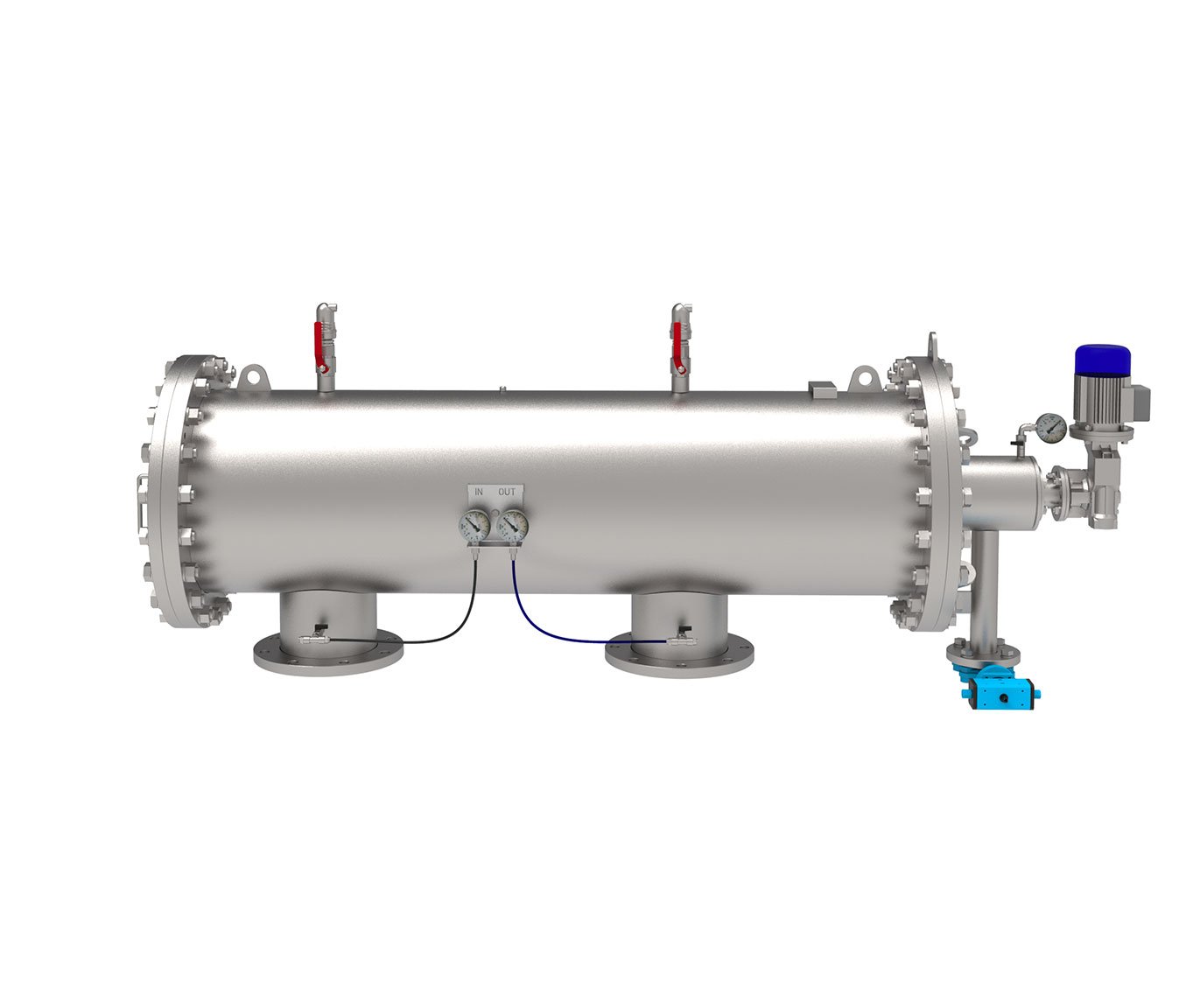
What Is a Self-Cleaning Water Filter?
A self-cleaning water filter is a screen filter with a built-in cleaning mechanism. Water passes through a stainless steel screen, and the screen traps particles above a set size, for example 100 µm. As dirt builds up, the pressure difference between the inlet and outlet rises. When it reaches a set point, the filter starts a short cleaning cycle and flushes the trapped dirt to drain.
The key difference from a manual strainer or cartridge filter is that nobody has to open the housing. The filter keeps working, day and night, with only a small amount of rinse water.
How Does a Self-Cleaning Water Filter Work?
There are several designs on the market, such as brush-type, backwash and suction-scanner filters. The suction-scanner type is the most common choice for medium and fine filtration. Here is how a typical cleaning cycle runs:
- Filtration: raw water enters the screen cylinder and flows from the inside out. Particles collect on the inner surface.
- Trigger: a differential pressure switch, a timer or the operator starts the cycle, usually at 0.3 to 0.5 bar.
- Flushing: the drain valve opens. Because the drain is at atmospheric pressure, water rushes backwards through small nozzles that sit against the screen.
- Scanning: an electric motor turns and moves the nozzles along the screen, so every part of the surface is vacuumed clean.
- Return to service: after 6 to 60 seconds the drain valve closes and normal filtration continues. Filtered water never stops flowing.
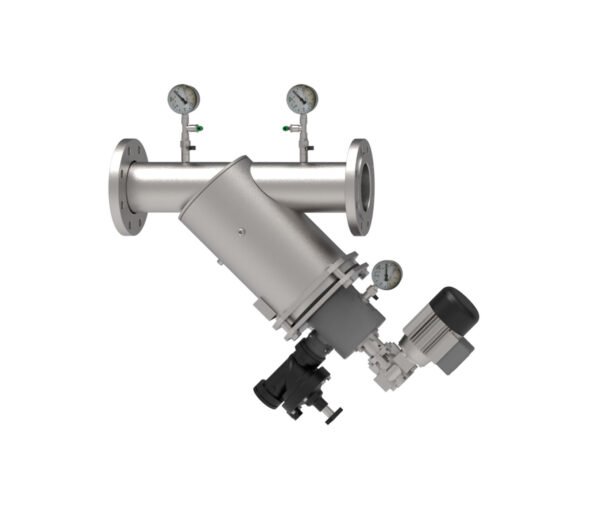
7 Proven Benefits of a Self-Cleaning Water Filter
1. No interruption to water supply
The filter cleans itself while it keeps filtering. Cooling towers, process lines and irrigation networks keep running without a bypass or shutdown.
2. Lower running cost
There are no disposable cartridges or bags to buy. The stainless steel screen lasts for years, so the main running cost is a small amount of electricity and rinse water.
3. Very low water loss
A well-designed self-cleaning water filter uses only 10 to 100 litres per cleaning cycle. On most sites this is less than 1% of total flow, much lower than a sand filter backwash.
4. Less labour and fewer site visits
Manual baskets and cartridges need someone on site to clean or change them. A self-cleaning filter handles this on its own, which is a major advantage for remote pump stations, farms and unmanned plants across Oman.
5. Protection for expensive equipment
Pumps, heat exchangers, spray nozzles, drip emitters and RO membranes are all damaged by sand and debris. A filter that never clogs gives them consistent protection.
6. Wide filtration range
Multi-layer screens cover filtration from 1,000 µm down to 10 µm, so one technology can handle coarse intake screening as well as fine pre-filtration.
7. Compact footprint
A self-cleaning screen filter takes far less floor space than a multimedia or sand filter of the same flow, which helps in crowded plant rooms.
Where Is a Self-Cleaning Water Filter Used in Oman?
Oman’s water sources are demanding. Borewells carry sand and silt, seawater intakes bring shells and algae, and treated sewage effluent (TSE) carries suspended solids. Typical applications include:
- Seawater and borewell intakes for desalination and RO plants
- Cooling towers and district cooling side-stream filtration
- Drip and sprinkler irrigation for farms, parks and landscaping
- Process water in oil and gas, power, steel and food plants
- TSE reuse for irrigation and industrial cooling
- Pre-filtration before ultrafiltration and cartridge filters
Self-Cleaning Water Filter vs Other Filters
| Feature | Self-cleaning screen filter | Manual basket strainer | Cartridge filter |
|---|---|---|---|
| Cleaning | Automatic, no flow stop | Manual, line isolated | Cartridge replacement |
| Consumables | None | None | Cartridges |
| Fine filtration (below 100 µm) | Yes | Limited | Yes |
| Labour | Very low | Medium | High at high solids |
| Best for | Continuous, high-solids duty | Pump protection, low solids | Final polishing |
For low-solids lines where a short shutdown is acceptable, a stainless steel basket strainer is a simpler choice. Where the water is dirty or the process cannot stop, the self-cleaning water filter is the better investment.
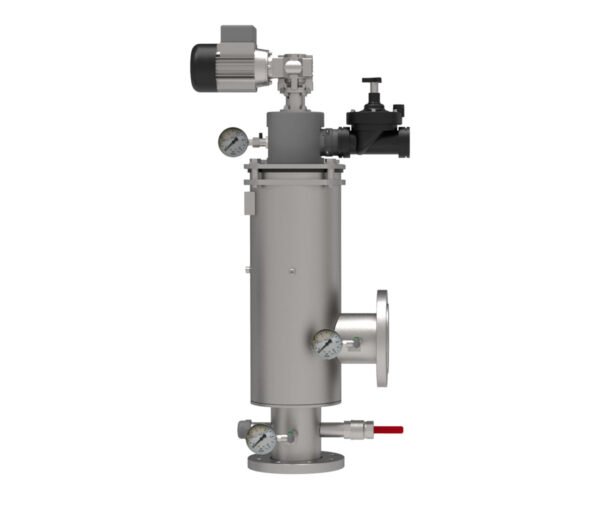
How to Choose the Right Self-Cleaning Water Filter
Getting the size right matters more than any other choice. Before you request a quotation, collect this information:
- Flow rate in m³/h, including peak flow
- Required filtration degree in µm, based on what you need to protect
- Water source and quality: TSS, turbidity, sand content, organics
- Operating pressure: most suction-scanner filters need at least 1.5 bar during cleaning
- Temperature and chloride level, which decide the material (AISI 304, AISI 316, duplex or super duplex)
- Power available on site and space for installation and maintenance
Finer screens need more screen area for the same flow. A filter that is too small will clean too often, waste water and wear faster. Our engineers size every unit against your actual water analysis.
Installation and Maintenance Tips
- Install isolation valves and a bypass so the filter can be serviced without stopping supply.
- Run the flush line to an open drain with no back pressure.
- Check the cleaning count and differential pressure weekly. A sudden rise in cleaning frequency means the water quality has changed.
- Inspect the screen and scanner nozzles every 6 to 12 months.
- Replace gaskets when they show wear.
For background on how screen filters are classified, see this overview of screen filters.
Our Recommended Self-Cleaning Water Filter: Alfa Water AVC (Made in Italy)
UV Water Systems supplies the Alfa Water AVC automatic self-cleaning filter, made in Italy. It uses a motor-driven suction scanner, cleans in 6 to 12 seconds, filters from 1,000 µm down to 10 µm and handles flows up to 1,850 m³/h with flanged connections from 2″ to 16″. Housings are available in AISI 304, AISI 316, SAF 2205 and 254 SMO for seawater duty.
Frequently Asked Questions
Does a self-cleaning water filter need compressed air?
Suction-scanner models like the AVC do not. They need only line pressure and a small electric motor.
How often does the filter clean itself?
It depends on the dirt load. On clean water it may clean a few times a day; on dirty intake water it may clean every hour. The cycle starts automatically when needed.
Can a self-cleaning water filter replace a sand filter?
For removing particles above 10 to 25 µm, often yes, and with far less backwash water. For turbidity and very fine particles, a media filter or ultrafiltration may still be needed after the screen filter.
Get Expert Advice in Oman
UV Water Systems is an ISO 9001:2015 certified water treatment company in Muscat. We size, supply, install and service self-cleaning filters across Oman, from Sohar to Salalah. Browse our filtration systems, request a quote or contact our team for a free consultation on the right self-cleaning water filter for your site. This guide is also available in Arabic.